Mostrando entradas con la etiqueta Córdoba. Mostrar todas las entradas

miércoles, 19 de febrero de 2014

La ciudad resplandeciente/ The shining city

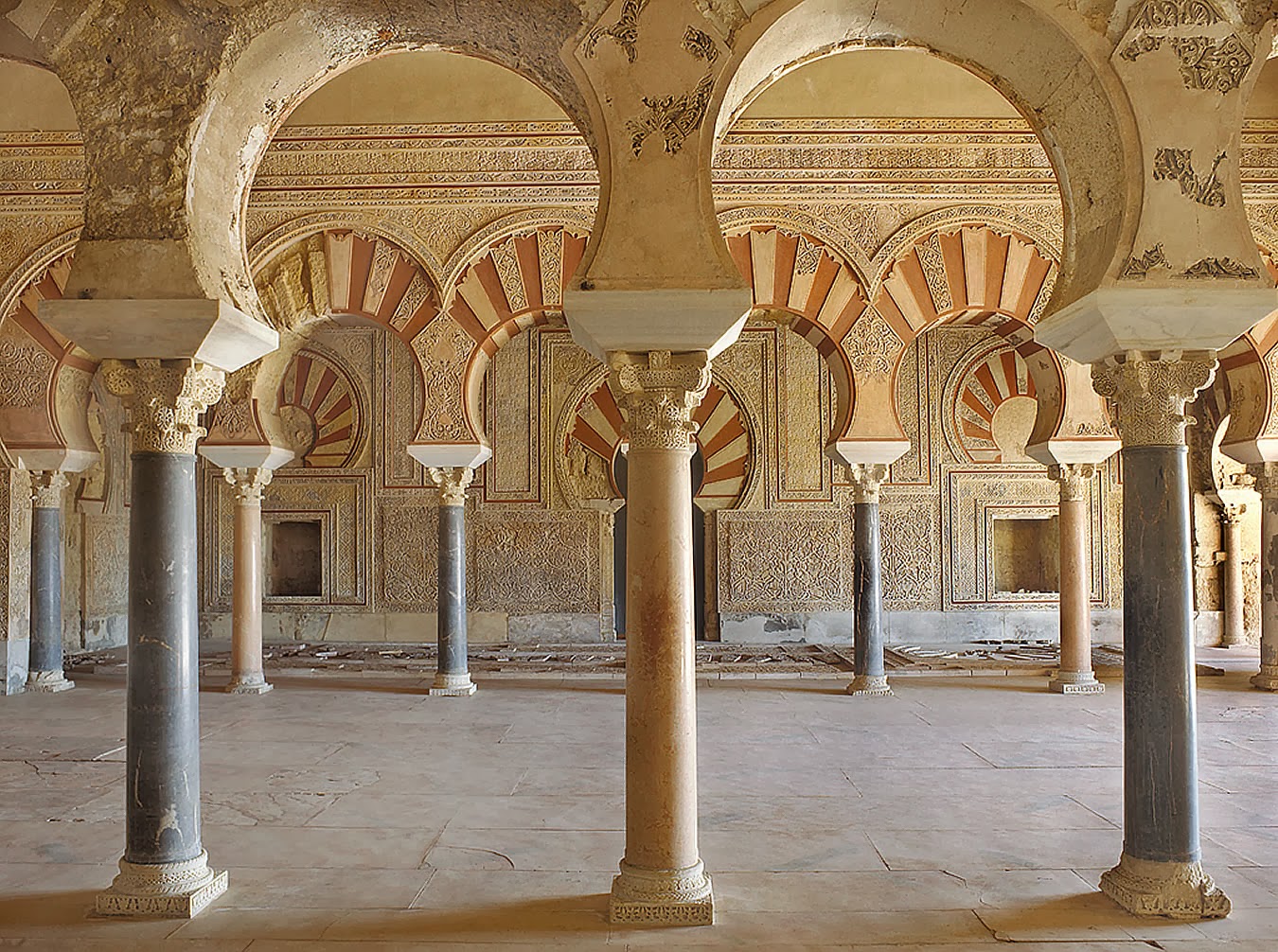
Salón de Abd al-Rahmán III. Junta de Andalucía.

Cuenta la leyenda que el primer califa de Al Ándalus, Abderramán III, amaba tanto a su favorita, al-Zahrá, que mandó construir la ciudad más bella del mundo para ponerle su nombre. La nueva ciudad se llamaría Madinat al-Zahrá, Medina Azahara. La ciudad de Azahara, la ciudad resplandeciente o la ciudad de la flor.

En realidad, los motivos fueron menos poéticos. Abderramán construyó la nueva ciudad en Sierra Morena a unos kilómetros de Córdoba, como símbolo de su poder y de su dignidad como califa. Imitaba así a otros califatos orientales.

Hasday Ibn Shaprut en la Corte de Abderramán III. Dionís Baixeras. 1885. Universidad de Barcelona.
Los cronistas hablan del inmenso desembolso que se hizo para construirla durante cuarenta años con el máximo lujo. Emperadores y reyes visitaron el lugar, que fue destruido en 1010 en la guerra civil que acabó con el Califato de Córdoba. Actualmente, sus ruinas todavía muestran parte del esplendor de una ciudad hecha por el amor a una mujer.

Más información acerca de Medina Azahara aquí.

@enriquevdiez
------------------------------------------------------------------------------------------------------------
The hall of Abd-ar-Rahman III. Junta de Andalucía.

According to legend, the first calyph of the Ummayad dynasty in al-Andalus, Abd ar-Rahman III, loved his favourite so much, al-Zahrá, that ordered to build the most beautiful city in the world to put her name on it. The new city might be called Madinat al-Zahrá, Medina Azahara. The city of Azahara, the brilliant city or the city of the flower.

In reality, the reason was less poetic. Abd-ar-Rahman built the new city in Sierra Morena, near Córdoba, as a symbol of his power and because of his dignity as caliph. He imited another Eastern calyphates.

Hasday Ibn Shaprut in the court of Abd ar-Rahman III. Dionís Baixeras. 1885. University of Barcelona.

Chroniclers relate about the huge expense done to build the luxurious city during forty years. Emperors and kings visited the place which was destroyed in 1010 in the civil war that ended the caliphate. Its ruins currently still shows a part of the splendour of a city made because of the love to a woman.

More information about Medina Azahara here.

@enriquevdiez
My english is not very good. I'm trying to improve it. If you find any errors in the text, please write to me (enriquevdiez@gmail.com). Thank you very much.

domingo, 1 de septiembre de 2013

El halcón de Andalus // The falcon of Andalus

Estatua de Abderramán I en Almuñécar (Granada)

Abderramán I fue el último príncipe Omeya. Su vida fue una auténtica epopeya que marcó en gran medida la primera fase de la historia musulmana de España.

Nieto del décimo califa Omeya, tuvo que huir de Abú Futrus cuando el primer califa abasí Abu-al-'Abbas masacró a la familia real omeya en el año 750 durante un banquete. Una profecía de su tío abuelo Maslama aseguraba que Abderramán restablecería la fortuna de su familia.

Tras numerosos avatares, acabó en Ceuta en 755 con algunos de sus fieles. Fue invitado a la península ibérica, donde el reino musulmán estaba muy debilitado por la carencia de un líder fuerte. Desde Algarinejo, provincia de Granada, lanzó un ataque con un ejército que reclutó y, poco a poco, fue conquistando las plazas fuertes de los andalusíes, a pesar de sus pocos efectivos. En Al-Musara, a las afueras de Córdoba, se enfrentó al emir Yusuf. Como no tenía bandera, improvisó una con un turbante verde y una lanza, símbolos que se convertirían en la bandera de los omeyas españoles. Venció y se hizo con el poder, pero tuvo que dedicar sus 32 años de reinado a acabar con las facciones rebeldes.

Su labor permitió organizar eficazmente el emirato e integrar a los distintos grupos religiosos bajo las leyes de Mahoma. Introdujo la palmera en la península ibérica y ordenó el uso del material de la basílica visigoda de San Vicente para la construcción de la mezquita de Córdoba, icono religioso de la España musulmana.

@enriquevdiez
------------------------------------------------------------------------------------------------------------
Statue of Abd al-Rahman I in Almuñécar (Granada)

Abd al-Rahman I was the last Umayyad prince. His life was a real epic story which marked greatly the first stage of the muslim history of Spain.

Grandson of the tenth Umayyad caliph, he had to flee from Abu Futrus when the first Abbasid caliph Abu-al-Abbas massacred the Umayyad royal family in 750 during a feast. A prophecy of his great uncle claimed that Abd al-Rahman would restore family's fortune.

After several vicissitudes, he ended up in Ceuta in 755 with some loyal people. He was invited to the Iberian peninsula, where the muslim kingdom was very weak because of the lack of a strong leadership. From Algarinejo, in the province of Granada, he attacked the land and, little by little, conquered the Andalusian strongholds, despite his short-staffed army. In the plains of Musara, just outside Córdoba, faced the emir Yusuff. Since he had no flag, improvised one with a green turban and a spear, symbols that would become in the flag of the Spanish Umayyad. Abd al-Rahman won the fight and seized power, but he had to spend his 32-year reign finishing the rebel factions off.

His work allowed an effective organization of the emirate and the integration of several religious groups under Muhammad law. He introduced the palm tree in Spain and used the materials of the Visigothic basilica of San Vicente in the construction of the mosque of Córdoba, religious icon of the muslim Spain.

@enriquevdiez
My english is not very good. I'm trying to improve it. If you find any errors in the text, please write to me (enriquevdiez@gmail.com). Thank you very much.

sábado, 13 de abril de 2013

Las cuentas del Gran Capitán// The Great Captain's sums


Estatua en bronce de Gonzalo Fernández de Córdoba. Detalle del monumento a Isabel la Católica, en el Paseo de la Castellana de Madrid. Manuel Oms y Canet.

Gonzalo Fernández de Córdoba, el Gran Capitán, es, según los expertos, uno de los mejores generales de la historia. Sus campañas en Italia garantizaron la supremacía española en esa península durante un siglo y medio. En batallas como las de Ceriñola, Garellano, Cefalonia, Ostia o Atella destrozó a los ejércitos francés y turco. Su reforma militar desembocó en la creación de los Tercios y la recuperación de la importancia de la infantería en la teoría militar, lo que revolucionó el arte de la guerra en los inicios de la Edad Moderna.

Cuenta la leyenda que al regresar de su campaña en Nápoles, el rey Fernando el Católico pidió al general cuentas sobre en qué había gastado el dinero de su reino. Gonzalo lo consideró un insulto. La versión más común de su respuesta fue la siguiente:

"Por picos, palas y azadones, cien millones de ducados; por limosnas para que frailes y monjas rezasen por los españoles, ciento cincuenta mil ducados; por guantes perfumados para que los soldados no oliesen el hedor de la batalla, doscientos millones de ducados; por reponer las campanas averiadas a causa del continuo repicar a victoria, ciento setenta mil ducados; y, finalmente, por la paciencia de tener que descender a estas pequeñeces del rey a quien he regalado un reino, cien millones de ducados".

La frase quedó en la cultura popular para responder a la petición de una relación pormenorizada o para negar una explicación a la que no se tiene derecho.


Ya que estamos, os contaré otra curiosidad del Gran Capitán. La estatua más famosa del general es la de la plaza de las Tendillas de Córdoba, realizada por Mateo Inurria. El bulo popular aseguraba que el rostro de la efigie era el del torero 'El Lagartijo'. Sin embargo, la historiografía ha demostrado que el modelo para la cabeza fue el organista de la iglesia de San Nicolás de la Villa.

@enriquevdiez

---------------------------------------------------------------------------------------------------------------------
Bronze statue of Gonzalo Fernández de Córdoba. Detail of the monument to Isabella of Castile, the Catholic.Madrid. Manuel Oms y Canet.

Gonzalo Fernandez de Córdoba, the Great Captain, is, according with the experts, one of the best generals ever. His Italian campaigns guaranteed the Spanish supremacy in that peninsula for 150 years. In battles like Cerignola, Atella, Ostia, Garigliano or Kefalonia, he destroyed the French and Turkish armies. His military reform culminated in the Tercio's creation and the recovery of the infantry's importance in the military theory. It revolutionized the art of war in the beginning of the Modern Age.

According to the legend, when he came back from the Naples campaign, the king Ferdinand the Catholic wanted to do sums with the general about the kingdom's money he had spent on the war. Gonzalo considered it an insult. The most common version about his reply was the newt one:

"For picks, shovel and mattocks, a hundred million ducats; for alms given to friars and nuns in order to pray for the Spanish men, one hundred and fifty thousand ducats; for scented gloves for the soldiers to avoid battle stench, two hundred million ducats; for replacing the broken bells because of the continuous ring of victory, a hundred and sixty ducats; and, lastly, for the patience having to explain this little things to a king who I gave a kingdom, a hundred million ducats".

The phrase was adopted by the common culture to answer the request of a detailed roster or to deny an explanation that somebody has no right.


Since we are talking about him, I'm going to tell you another curiosity about the Great Captain. The general's most famous statue is placed in the Tendillas square, in Córdoba. It was made by Mateo Inurria. The popular hoax claimed that the statue's face represented the bullfighter 'El Lagartijo'. Nevertheless, the historiography has shown that the model for the statue's head was the organist of San Nicolás de la Villa church.

@enriquevdiez

My English is not very good. I'm trying to improve it. If you find any errors in the text, please write to me (enriquevdiez@gmail.com). Thank you very much.