Mostrando entradas con la etiqueta Al-Ándalus. Mostrar todas las entradas

viernes, 2 de enero de 2015

Ciencias españolas (I): Inventos / Spanish sciences (I): Invents

 
Ictíneo de Narciso Monturiol. Museu Marítim de Barcelona.

La leyenda negra española ha provocado que, durante siglos, se considere a la ciencia española como atrasada y falta de inventiva. En esta serie de artículos, trataré de hacer una introducción histórica de algunas aportaciones españolas a la Humanidad.

Los antecedentes de las patentes modernas fueron los privilegios de invención implantados en el siglo XV (el primero se creó en Florencia en 1421; el segundo en Venecia, en 1474; y el tercero en Castilla, en 1479). El primer privilegio hallado en un archivo español fue el concedido en Sevilla a Pedro Azlor por su sistema de molienda de harina. La reina Isabel la Católica protegió el invento en todos sus reinos por 20 años para que solo el inventor designase quién podía utilizarlo. En 1522, estos privilegios se convirtieron en reales cédulas. En 1679, en plena decadencia política, militar y socioeconómica, Juan José de Austria creó la Real Junta General de Comercio, dentro de su política reformista, para promover, desde tesis mercantilistas, las instituciones educativas y la protección de artistas, fabricantes y comerciantes. En 1788 se fundó el Real Gabinete de Máquinas del Buen Retiro, primera institución española destinada a la recopilación de información tecnológica y su difusión. La primera ley de patentes la decretó José I Bonaparte en 1811 y las Cortes de Cádiz regularon en 1812 la propiedad industrial. Estas instituciones evolucionarían hasta la actual Oficina Española de Patentes y Marcas. En este primer artículo, me centraré en algunas invenciones.

Manuscrito de Jerónimo de Ayanz con la explicación de la máquina de vapor.

 - La máquina de vapor moderna y el barco de vapor. Aunque la máquina de vapor fue inventada Herón de Alejandría en al antigüedad y hubo usos medievales como el del órgano a vapor de la catedral de Reims, la primera máquina de vapor moderna como tal fue inventada y patentada por Jerónimo de Ayanz en 1606. Su ingenio fue aplicado para achicar agua en la mina sevillana de Guadalcanal, donde aplicó otro invento: el aire acondicionado. El primer modelo de barco de vapor fue inventado por Blasco de Garay en 1543. Probó su invento en el puerto de Barcelona, aunque no contó con la financiación suficiente para producirlo en serie.


- El galeón, la fragata y el destructor. Si la carabela fue un invento portugués, el galeón fue creado en el siglo XVI en España para responder a las necesidades transoceánicas imperiales, aunque su polivalencia la convirtió en un navío clave para naciones con poca tradición naval, lo que contribuyó a su internacionalización. En el caso de la fragata, aunque la primera producción se debe a los holandeses, las primeras naves denominadas de esta manera fueron las utilizadas por los corsarios españoles en la Guerra de los Ochenta Años contra los rebeldes. Por último, el destructor fue diseñado por Fernando Villamil en 1885 (cuatro años de la construcción del navío japonés 'Kotake', tradicionalmente considerado primer navío de este tipo) y construido en los astilleros ingleses de James and George Thompson para luchar contra los buques torpederos.

 Plano del Garcibuzo de Cosme García Sáez.

- El vehículo submarino. Los sumergibles habían sido probados en la Edad Moderna por unos griegos en la corte de Carlos I en 1562 y por Ayanz en 1600. Sin embargo, los primeros vehículos submarinos fueron el Garcibuzo de Cosme García Sáez en 1859 (hundido por su creador al no encontrar financiación), los Ictíneos de combustión interna de Narciso Monturiol en 1864 y el submarino eléctrico de Isaac Peral en 1888 (no superado hasta la creación del submarino nuclear de USS Nautilus).

 Herrera trabaja en el primer traje espacial. Nationaal Archief
- El traje de astronauta. El ingeniero granadino Emilio Herrera, presidente del Gobierno republicano en el exilio, inventó la escafandra estratonáutica en 1935, el primer traje diseñado para el viaje espacial, modelo que copiaría la NASA 20 años más tarde.

 Autogiro Cierva C-30.

- El paracaídas y el autogiro. El sabio andalusí Abbás Ibn Firnás fue el primer hombre de la historia que realizó intentos científicos de volar. En el año 852 se lanzó desde una torre de Córdoba sujeto a una enorme lona para amortiguar la caída, convirtiéndose en el precursor del paracaídas. Años después voló unas decenas de segundos con unas alas de madera, seda y plumas. El autogiro fue diseñado por Juan de la Cierva en 1923. Introdujo posteriormente mando directo sobre el rotor y obteniendo, mediante un prelanzador (que había sido probado previamente por Heraclio Alfaro Fournier), un despegue casi vertical. Aunque con notables diferencias, este invento fue una alternativa al helicóptero creado por el argentino Raúl Pateras de Pescara, al igual que la libélula española ideada por Federico Cantero.

Aritmómetro electromecánico de Leonardo Torres Quevedo.

- El radiocontrol, la inteligencia artificial, el videojuego, el ordenador y el libro electrónico. Leonardo Torres Quevedo inventó y patentó antes que Nikola Tesla (que se le había adelantado en 5 años en el descubrimiento de la radio) el telekino, o primera máquina de radiocontrol del mundo en 1903. Con ella, controlaba a un autómata mediante ondas hertzianas (posteriormente, Matías Balsera inventaría el sistema de sintonización y codificación de frecuencias). A finales de 1913, presentó 'el ajedrecista', primera manifestación de inteligencia artificial y del primer videojuego de la historia. Se trataba de otro autómata con el que podía jugarse un final de partida de ajedrez. Por último, fue el pionero del ordenador moderno al presentar en 1920 (ya lo había ideado teóricamente años antes en sus 'Ensayos') un aritmómetro electromecánico que poseía las unidades que constituyen cualquier computadora: unidad aritmética, unidad de control, memoria, y órgano de salida e impresión de datos. El primer libro electrónico fue creado por la maestra Ángela Ruiz Robles en 1949 con la idea de aligerar el peso de la cartera de los niños.


- La falcata y el arcabuz. El arma más mortífera de la antigüedad fue incorporada y adaptada a la impedimenta de la tropa romana después de que los íberos hiciesen una carnicería con sus falcatas en la batalla de Cannas. En cuanto al arcabuz, aún está en discusión si fue descubierto por españoles, húngaros o alemanes. No obstante, fue un invento que revolucionó el arte de la guerra junto al cañón y la pica en la Edad Moderna.

Otros inventos destacados: el tren talgo, el sistema submarino de reciclaje de aire, el aparato portátil de rayos X, el modelo con escaleras de Valturio, la guitarra, el laúd, el cigarrillo, la fregona, el chupachups, el forceps, el laringoscopio, los quevedos, el futbolín, el puente transbordador, el torquetum, el cabestrante, la jeringuilla desechable, la navaja, la grapadora, el afilalápices eléctrico, el barociclonómetro, el nefoscopio, el microsismógrafo, la llave de miquelete, el sillón ergonómico, el astrolabio de al-Sahlî, la máquina de ejercicios gimnásticos, la mesa plegable, el botijo...

Facebook
----------------------------------------------------------------------------------------------------------------------
 
Narciso Monturiol Ictíneo. Museu Marítim de Barcelona.


The Spanish Black Legend has caused that, during centuries, Spanish Science has been considered backward and lack of inventiveness. In this post series, I'm going to try a historical introduction to several Spanish contribution to mankind.

The ancestors of modern patents were the invention privileges, set up in XV century (first in Florence in 1421; second in Venice, in 1474; third in Castile, in 1479). The first privilege found in a Spanish archive was a flour windmill invented by Pedro Azlor. Queen Isabella I protected the invention during 20 years allowing that only the inventor should designate who could use it. In 1522, these privileges became royal documents. In 1679, in the middle of a political, military, socioeconomic decline, Juan José de Austria created the Real Junta General de Comercio (General Trading Royal Committee), inside his reforming mercantilist policy, to promote the educational institutions and the protection of artists, manufacturers and businessmen. In 1788, the Real Gabinete de Máquinas del Buen Retiro (Buen Retiro's Royal Machine Office) was founded. It was the first Spanish institution destinated to gather together the technological information and its dissemination. The first patent law was ordered by Joseph I Bonaparte in 1811 and the Court of Cadiz regulated the industrial property. These institutions evolved until the current Oficina Española de Patentes y Marcas (Spanish Office of Patents and Trademarks). In this first post, I'm going to write about many inventions.

Jerónimo de Ayanz manuscript with the explanation about his steam engine. 

- The modern steam engine and the steamboat. Despite the steam engine was invented in the Ancient Age by Hero of Alexandria and there were medieval uses, as in the steam organ of the cathedral of Rheims, the first modern steam engine was invented and patented by Jerónimo de Ayanz in 1606. His devices were used to bale out water from the mine of Guadalcanal (Seville), where made use of another invention: the air conditioning. The first steamboat model was developed by Blasco de Garay in 1543. He checked his discovery in Barcelona's harbour. Nevertheless, he couldn't find enough funding to go into series production.


- The galleon, the frigate and the destroyer. While the carabel was a Portuguese invention, the galleon was created in XVI century in Spain to answer to the imperial transoceanic needs, although its versatility make it into a key ship to the nations which had a poor naval tradition, that contributed to its internationalization. In the case of the frigate, despite the first mass production was Dutch, the first models were used by Spanish privateers in the Eighty Years' War against rebels. Lastly, the destroyer was designed by Fernando Villamil in 1885 (four years before the development of the Japanese ship 'Kotake', traditionally considered the first vessel of this type) and made in James & George Thompson's shipyard to fight against torpedo boats.

Drawing of the Cosme García Sáez Garcibuzo.

- The submarine. The first waterproof vehicles were tested by Greek engineers in Charles V court in 1562 and, later, by Ayanz in 1600. Nevertheless, the first submarines were Cosme García Sáez 'Garcibuzo' in 1859 (sunk by its creator because of the lack of funding), Narciso Monturiol internal combustion submarine 'Ictineus' in 1864, and Isaac Peral electrical submarine in 1888 (whose model would stand until the development of the nuclear submarine USS Nautilus).

Herrera working in his spacesuit. Nationaal Archief.


- The space suit. The engineer from Granada Emilio Herrera, president of the Republican Government in the exile, invented the stratonautical suit in 1935, the first costume designed to the space travel, model that would be copied by NASA 20 years later.

 Autogiro Cierva C-30.

- The parachute and the autogiro. The Andalusian wiseman Abbas Ibn Firnas was the first man in history who made scientific attempts to fly. In 852, he leaped on from a tower of Cordoba fastened to a huge canvas to cushion the fall, becoming the forefather of the parachute. Several years later, he flied many seconds with a wings made of wood, silk and feathers. The autogiro was designed by Juan de la Cierva in 1923. He made later many improvements in the machine as a direct control over the rotor or obtaining, by a prethrower (that had been invented before by Heraclio Alfaro Fournier), an almost vertical takeoff. Despite the significant differences, this invent was an alternative of the helicopter, created by the Argentinian Raúl Pateras de Pescara, as the Spanish 'Dragonfly', conceived by Federico Cantero.

Leonardo Torres Quevedo electromechanical arithmometer.


- The radio control, the artificial intelligence, the videogame, the computer and the electronic book. Leonardo Torres Quevedo invented and patented before Nikola Tesla (who had discovered the radio five years before him) the 'telekino', that was the first radio control machine over the world in 1903. It allowed him to control an automaton by hertzian waves (subsequently, Matías Balsera would invent the tuning and coding frequency system). At the end of 1913, he presented 'The Chess Player', first device made with artificial intelligence and the first videogame. It was another robot who can play the end of a chess game. Finally, he was the pioneer of the current computer when he presented in 1920 (he had already conceived it years before in his 'Ensayos') his electromechanical arithmometer. It had the units of any computer: arithmetic unit, control unit, memory, exit unit and data printing. The first electronic book was created in 1949 by Ángela Ruiz Robles, a teacher who tried to make lighter the weight of children school bags.


- The falcata and the arquebus. The most lethal ancient weapon was incorporated and adapted to Roman Army 'impedimenta' after Iberians doing a slaughter with their 'falcatas' a slaughter on them in the battle of Cannae. Experts still discuss if arquebus was discovered by Spaniards, Hungarians or Germans. However, it was an invent that shook up the art of war in the Modern Ages together with cannon and the pike.

Another renowned invents: the talgo train, the submarine recycling air system, the X ray portable machine, the Valturius' stairway model, the guitar, the lute, the cigarette, the mop, the lollipop, the forceps, the laringoscope, the quevedos glasses, the table football, the ferry bridge, the torquetum, the capstan, the disposable syringe, the razor, the stapler, the electrical pencil sharpener, the barocyclonometor, the nephoscope, the microseismometer, the Miquelet lock, the ergonomic chair, al-Sahlî's astrolab, the gym machine, the folding table, the earthenware pitcher...

@enriquevdiez
Facebook
My English is not very good. I'm trying to improve it. If you find any errors in the text, please write to me (enriquevdiez@gmail.com). Thank you very much.

miércoles, 12 de noviembre de 2014

¿Reconqué? / Reconwhat?

Entrega de Granada. Francisco Pradilla. 1882.

Todos los colegios enseñan que los reinos cristianos medievales de la península ibérica 'reconquistaron' el territorio a los musulmanes. Sin embargo, esta afirmación, lejos de ser correcta, fue una construcción propagandística para sustentar las campañas de dichos reinos para hacerse con regiones tomadas por el Islam. Como dijo Ortega y Gasset: "Una reconquista de ocho siglos no es una reconquista".

El Islam conquistó la mayor parte de la península ibérica e impuso su dominio al resto en apenas tres décadas tras vencer en la batalla de Guadalete en el año 711 a los visigodos y acabar con su reino. Tras alrededor de tres siglos de vigor político, la presencia musulmana en la península entró en declive hasta su desaparición con la conquista del reino nazarí de Granada por los Reyes Católicos en 1492. Hay una rama de la historiografía que defiende que existe Reconquista desde el principio de la invasión musulmana ya que el mítico rey asturiano Pelayo venció a los musulmanes en una escaramuza en Covadonga en 722. Sin embargo, otra buena parte de los profesionales discute la importancia histórica de este hecho y pone de manifiesto que gran parte de la población hispanovisigoda se acomodó al nuevo gobierno centralizado que implantaron los sucesivos gobiernos islámicos.

Entonces, ¿de dónde viene la idea de la reconquista? El rey Leovigildo conquistó territorios cántabros, bastetanos, malagueños, aragenses, sabarios, suevos, bizantinos, cordobeses y orospedanos, antes de fundar la ciudad de Recópolis. El cronista Juan de Bíclaro se refirió a estas victorias en 578 como una reintegración de los dominios visigodos, a pesar de que fue una conquista de suelo ajeno. Y es que consideraban a Hispania como una unidad geográfica cuya soberanía les correspondía, después de que apenas 50 años antes los terratenientes hispanorromanos transfiriesen sus lealtades primero al rey Ataúlfo y, posteriormente, en mayor medida, a Eurico, al entender que el poder imperial romano solo se sostenía por el apoyo de los visigodos, que actuaban como pueblo federado de los romanos en Hispania y la Galia. Así, la monarquía hispanogoda se reconoció política y legalmente heredera y sucesora de Roma en la península. Suintila se autoproclamó 60 años después rey de las Spanias al lograr la unificación peninsular tras expulsar a los bizantinos. Este título fue utilizado indistintamente por gobernadores cristianos e islámicos ibéricos para tratar de imponer su hegemonía legal sobre el resto, a modo de emperador hispánico. De hecho, fue utilizado legalmente hasta la unificación del Estado por Felipe V mediante los decretos de Nueva Planta, promulgados a principios del siglo XVIII.

Los gobernantes de los diversos estados cristianos, descendientes del reino asturiano y de la Marca Hispánica franca, se consideraron a sí mismos a menudo como herederos legítimos y de sangre de los godos, mecanismo legal con el que justificaron sus políticas expansionistas hacia el sur musulmán. Por eso hablaron de reconquista, a pesar de que tomaban territorios en los que la mayoría social era tan hispana como ellos. A los reyes cristianos tardomedievales y de la Edad Moderna también les benefició mantener este concepto para reforzar algunos aspectos de su política religiosa y sus proyectos de unificación del Estado.

Facebook
--------------------------------------------------------------------------------------------------------------------------
The Capitulation of Granada. Francisco Pradilla. 1882.

All schools taught that the Iberian Christian medieval kingdoms 'reconquered' the peninsular territory to the Muslims. Nevertheless, this statement is far from being correct. It was a propaganda construction to hold those kingdoms' campaigns to get regions taken by Islam. As Ortega y Gasset said: "An eight century reconquest is not a reconquest".

Islam conquered  most of the Iberian peninsula and imposed its power in three decades after its victory against Visigoths in the battle of Guadalete in 711, ending its kingdom over Hispania. After three centuries of political vigour, Muslim presence in the peninsula went into decline until its dissapearance in the conquest of the Nasrid kingdom of Granada by the Catholic Monarchs in 1492. A branch of historiography defends that Reconquista exists from the beginning of the Muslim invasion because of the mythic Asturian king Pelagius defeated Muslims in Covadonga in 722. Nevertheless, another experts discuss the historical importance of this fact and shows that a large portion of Hispano Visigothic population adjusted to the new centralized government that was set up by consecutive Islamic government.

Then, where does the idea come? King Liuvigild conquered territories from Cantabria, Bastetania, Malaga, Orense (Aragense country), Sabaria, Suevi, Spanish Byzantium, Cordoba and Orospeda, before the foundation of Reccopolis. The chronicler Juan de Bíclaro alluded these victories in 578 as a return to the Visigothic possession, despite they were a conquest abroad. Visigoths considered Hispania as a geographic unit whose sovereign belonged themselves. Hispanic Roman landowners had transfered their loyalty to these Germanic people 50 years ago, in the person of king Ataulf, first, and king Eric, in a greater extent. They understood that Roman Imperial power was only maintained with the Visigothic support, that was acting as a federated people in Hispania and Gaul. Thus, the Hispanic Gothic monarchy recognized itself, politically and legally, as the Roman heir and successor in the peninsula. Suintila declared himself king of the Spanias 60 years after because of the peninsular unification after the expulsion of the Byzantine army. This title was used equally by Christian and Islamic Iberian governors with the intention of imposing their supremacy on the rest, as an Hispanic emperor. In fact, it was used legally until the unification of the Spanish State by Philip V by Nueva Planta decrees, published in the beginning of XVII century.

Governors of the different Christian states, descendants of the Asturian kingdom and the Frank Marca Hispanica, considered themselves often as legal and blood heirs of the Goths, as a lawful mechanism to justify their expansionist politics against the Muslim peninsular south. That is why they talked about reconquest, despite they captured territories where the social majority were as Spaniard as them. Late-medieval and Modern Christian kings benefited from maintain this concept to reinforce several aspects of their religious politics and their unification projects.

@enriquevdiez
Facebook
My English is not very good. I'm trying to improve it. If you find any errors in the text, please write to me (enriquevdiez@gmail.com). Thank you very much.

martes, 16 de septiembre de 2014

Himnos de España (I): El himno andalusí / Spanish hymns (I): The Andalusian hymn


Algunos musicólogos defienden que la obertura instrumental del movimiento Dary de la Nuba al-Istihlál es el origen del himno de España, aunque no hay estudios científicos que sustenten tal afirmación. Existen varias tesis sobre su origen. La más extendida es que esta pieza pertenece a la tradición musical andalusí de Marruecos. No obstante, hay expertos que defienden que la partitura es obra del filósofo de Saraqusta (Zaragoza) Ibn Bayyah (Avempace), que vivió en dicho reino de taifa entre los siglos XI y XII.


------------------------------------------------------------------------------------------------------------
Palace of the Aljafería (Zaragoza).

Many musicologists defend that the instrumental oberture of the movement Dary of the Nuba al-Istihlál is the origin of the Spanish hymn, although there are no scientific studies to base this assertion. There are several theories about its origin. The most common is that this piece belongs to the Moroccan Andalusian musical tradition. Nevertheless, there are experts who argue that the author of the original score is the phylosopher of Saraqusta (Zaragoza) Ibn Bâjja (Avempace) who lived in that taifa kingdom between XI and XII centuries.


@enriquevdiez
Facebook
My English is not very good. I'm trying to improve it. If you find any errors in the text, please write to me (enriquevdiez@gmail.com). Thank you very much.

martes, 18 de marzo de 2014

La venganza del conde don Julián / The revenge of count Julian


Cuenta una leyenda árabe que don Julián, conde de Ceuta, envió a su hija Florinda a Toledo para que fuese educada en la corte visigoda y encontrase marido. El rey Rodrigo sufría sarna y eligió a la joven para que se la limpiase con un alfiler de oro. El monarca la violó y ella mandó al padre varios regalos entre los que había un huevo podrido. Don Julián comprendió lo que había ocurrido. Fue a Toledo a reclamar a su hija con la excusa de que su mujer estaba muy enferma y solo la visión de Florinda la haría mejorar. Rodrigo le dio permiso. Cuando don Julián llegó a Ceuta, entabló conversaciones con Musa ibn Nusair para que desembarcase en la península ibérica. Fue el principio del fin de los visigodos.

Esta leyenda es la más común entre las numerosas que hablan de la caída del último rey visigodo. Los historiadores no se ponen de acuerdo sobre cuáles fueron las causas que permitieron la entrada de los musulmanes en la península ibérica. Al parecer, Rodrigo tomó violentamente el poder a la muerte de Witiza en el reino, aunque algunas fuentes señalan que Agila II también gobernaba en algunas zonas. La situación de guerra civil, de enfrentamiento de la aristocracia, el intervencionismo eclesiástico, la crisis agraria y las querellas dinásticas permitieron a un pequeño contingente musulmán asaltara con éxito el reino. La batalla de Guadalete y la toma de Toledo, en el año 711, fueron los hitos que abrieron la puerta peninsular al Islam.

@enriquevdiez
------------------------------------------------------------------------------------------------------------

According to an Arabian legend, Julian, count of Ceuta, sent his daughter Florinda to Toledo to be educated in the Visigothic court and found a husband. The king Roderic suffered scabies and chose the young woman to clean him with a golden pin. The monarch raped her and Florinda sent her father many presents, including a rotten egg. Julian understood what had happened. He went to Toledo to require his daughter with the excuse that his wife was very ill and only the vision of Florinda would be able to recover her. Roderic authorised them. When Julian arrived at Ceuta, he initiated exploratory talks with Musa ibn Nusair to allow him to disembark his troops in the Iberian peninsula. It was the beginning of the end of the Visigoths.

This legend is the most common among the stories about the fall of the last Visigothic king. Historians can't agree about which causes allowed Muslims to penetrate in the Iberian peninsula. It seems that Roderic took kingdom power violently after Wittiza's death, although some fonts note that Achila II ruled some areas. The civil war situation, the aristocratic confrontation, the ecclesiastical interventionism, the dynastic quarrels, and the agrarian crisis permitted a small Muslim army to assault the kingdom. The battle of Guadalete and the fall of Toledo, in 711 aC, were the milestones which opened the peninsular door to the Islam.

@enriquevdiez
My english is not very good. I'm trying to improve it. If you find any errors in the text, please write to me (enriquevdiez@gmail.com). Thank you very much.

miércoles, 19 de febrero de 2014

La ciudad resplandeciente/ The shining city

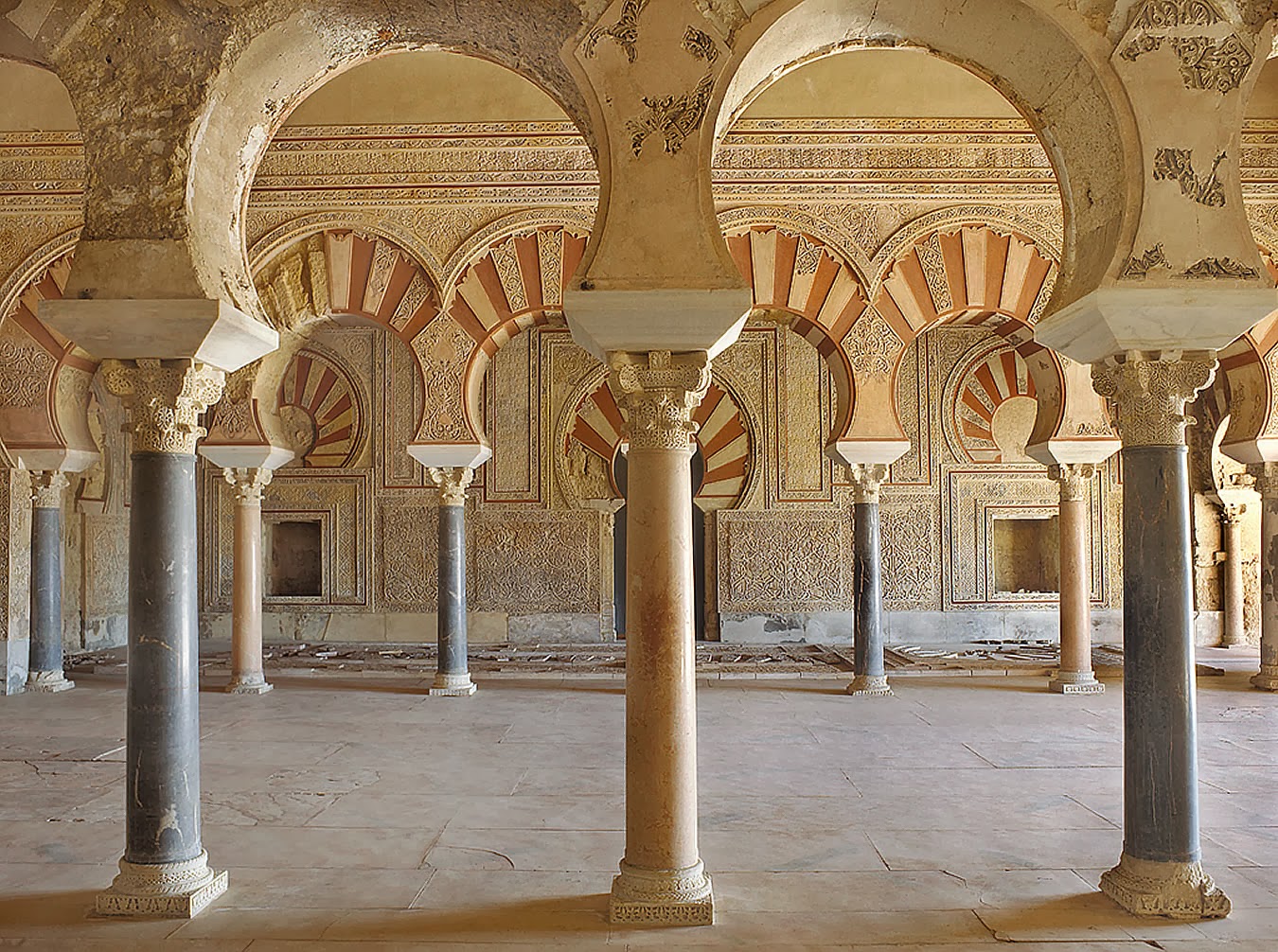
Salón de Abd al-Rahmán III. Junta de Andalucía.

Cuenta la leyenda que el primer califa de Al Ándalus, Abderramán III, amaba tanto a su favorita, al-Zahrá, que mandó construir la ciudad más bella del mundo para ponerle su nombre. La nueva ciudad se llamaría Madinat al-Zahrá, Medina Azahara. La ciudad de Azahara, la ciudad resplandeciente o la ciudad de la flor.

En realidad, los motivos fueron menos poéticos. Abderramán construyó la nueva ciudad en Sierra Morena a unos kilómetros de Córdoba, como símbolo de su poder y de su dignidad como califa. Imitaba así a otros califatos orientales.

Hasday Ibn Shaprut en la Corte de Abderramán III. Dionís Baixeras. 1885. Universidad de Barcelona.
Los cronistas hablan del inmenso desembolso que se hizo para construirla durante cuarenta años con el máximo lujo. Emperadores y reyes visitaron el lugar, que fue destruido en 1010 en la guerra civil que acabó con el Califato de Córdoba. Actualmente, sus ruinas todavía muestran parte del esplendor de una ciudad hecha por el amor a una mujer.

Más información acerca de Medina Azahara aquí.

@enriquevdiez
------------------------------------------------------------------------------------------------------------
The hall of Abd-ar-Rahman III. Junta de Andalucía.

According to legend, the first calyph of the Ummayad dynasty in al-Andalus, Abd ar-Rahman III, loved his favourite so much, al-Zahrá, that ordered to build the most beautiful city in the world to put her name on it. The new city might be called Madinat al-Zahrá, Medina Azahara. The city of Azahara, the brilliant city or the city of the flower.

In reality, the reason was less poetic. Abd-ar-Rahman built the new city in Sierra Morena, near Córdoba, as a symbol of his power and because of his dignity as caliph. He imited another Eastern calyphates.

Hasday Ibn Shaprut in the court of Abd ar-Rahman III. Dionís Baixeras. 1885. University of Barcelona.

Chroniclers relate about the huge expense done to build the luxurious city during forty years. Emperors and kings visited the place which was destroyed in 1010 in the civil war that ended the caliphate. Its ruins currently still shows a part of the splendour of a city made because of the love to a woman.

More information about Medina Azahara here.

@enriquevdiez
My english is not very good. I'm trying to improve it. If you find any errors in the text, please write to me (enriquevdiez@gmail.com). Thank you very much.

jueves, 14 de noviembre de 2013

La música española (I): la Edad Media / The Spanish music (I): the Middle Ages


En los próximos artículos trataré de mostrar una pequeña historia de la música española.

La música hispánica propiamente dicha comienza en la Edad Media. En la península ibérica confluyen numerosas culturas que aportan su herencia cultural: los romanos, los visigodos, los bizantinos, los judíos y los árabes.

En el siglo VIII, los visigodos desarrollaron las primeras notaciones musicales de origen hispano, las neumas visigóticas, empleadas para anotar el canto y la música sacra. Era el canto mozárabe o hispano, asociado a la liturgia hispánica, que se conservó tanto entre los reinos cristianos del norte como entre los cristianos que vivían entre musulmanes. Cayó en desuso al implantarse el rito romano.


En Al-Ándalus surgió una vertiente regional de las músicas norteafricanas. Los reinos musulmanes peninsulares eran importantes centros de manufactura de instrumentos. Productos como el laúd, el rabel, la guitarra, las castañuelas, la dulzaina, la gaita, la cítara o el violín, entre otros, son la herencia de los instrumentos que desde allí se exportaron a los reinos de toda Europa. Está demostrado que la música andalusí influyó en la sensibilidad de los trovadores franceses.


El género no funcionó igual de bien a este lado de los Pirineos, aunque hubo varios reyes trovadores. Cataluña y Aragón fueron los núcleos más importantes en esta materia. Sin embargo, en otros lugares de la geografía ibérica hubo variantes de este fenómeno, como las cantigas.


Los judíos instalados en Castilla y Aragón fusionaron las músicas de cristianos y árabes y les aportaron sus tradiciones rítmicas e instrumentales, creando la música sefardí, que se exportó por todo el mundo tras su expulsión en tiempos de los Reyes Católicos.Otra variante fue la música ladina, cantada en la lengua hispano judía.


A partir del siglo XI, la polifonía se generalizó en la península. La liturgia hispánica se sustituyó por la romana y se implantaron las piezas litúrgicas 'oficiales' de la Iglesia. Los 'conductus', 'organum' y 'motetes' se convirtieron en la columna vertebral del 'Ars Antiqua', para el que España aportó una de las fuentes musicales más importantes del período: el 'Codex Calixtinus', dedicado al apóstol Santiago. Las aportaciones que se van realizando desde toda Europa marcan la 'Ars Nova', que en España vive su máximo esplendor en Cataluña, con el Llibre Vermell como máximo exponente. Estos avances polifónicos dan pie a la aparición de las canciones cortesanas del Renacimiento.


@enriquevdiez
------------------------------------------------------------------------------------------------------------
Picture of the Cantigas de Santa María

In the next posts I will try to show a little history of the Spanish music.

The actual Hispanic music started in the Middle Ages. In the Iberian peninsula converged many cultures that provided their cultural legacy: Romans, Visigoths, Byzantines, Jews and Arabs.

In VIII century, Visigoths developed the first Spanish musical notation, the Visigothic neumes, used to write down the singing and the sacred music. It was the Mozarabic chant, related to the Hispanic liturgy, which was kept in the Northern peninsular Christian kingdoms and between Christians who lived with the Muslims as well. It fell into disuse when Roman rite was introduced.


In Al-Andalus emerged a regional aspect of the North African musics. Peninsular Muslim kingdoms were important manufacturing centers of musical instruments. Products as the lute, the ravel, the guitar, the castanets, the pipe, the bagpipe, the citar, the violin, among others, are the legacy of the exported instruments from there to th whole Europe. It's now accepted that the Andalusian music had influence in the French troubadours' sensitivity.


The genre didn't work as well in this side of the Pyrenees mountains although there were some troubadour kings. Catalonia and Aragon were the most important hearts of this music. Nevertheless, in other places of the peninsula there were regional versions of that style. For example, the 'cantigas'.


Jewish people who lived in Castile and Aragon mixed Christian and Arab musics, and  contributed their rythmic and instrumental traditions, creating the Sephardic music, which was exported around the world when they were expelled in the time of the Catholic Monarchs. A version of this music was the Ladino music, sung in the Jewish Spanish language.


Since XI century, poliphony spread in the peninsula. The Hispanic liturgy was replaced by the Roman one and new 'official' liturgical songs were instituted. The 'conductus', 'organum' and 'motette' became the backbone of the 'Ars Antiqua', for which Spain contributed with one of the most important musical sources of the period, the Codex Calixtinus, dedicated to the apostle Saint James. Contributions that were made from Europe resulted in the 'Ars Nova'. Spain lived its highest peak in Catalonia, with the appearance of the 'Llibre Vermell'. These poliphonic progress gave rise to the courteous songs of the Renaissance.


@enriquevdiez
My english is not very good. I'm trying to improve it. If you find any errors in the text, please write to me (enriquevdiez@gmail.com). Thank you very much.

martes, 3 de septiembre de 2013

Los jueces 'indignados' // The 'outraged' judges


Jueces de Castilla. Arco de Santa María. Burgos.

En 920, Ordoño II, rey de Galicia y León, mandó llamar a cuatro condes castellanos a su corte. Al llegar, los ejecutó al considerar que su derrota en la guerra con los musulmanes se debía a que los magnates de Castilla no le habían acompañado en la campaña.

Cuenta la tradición que los castellanos, indignados ante esta acción y no pudiendo levantarse en armas, decidieron proveerse de gobierno, eligiendo dos magistrados entre la nobleza para hacer justicia sin oprimir al pueblo ni menoscabar su libertad.

Estos jueces actuaron basándose en los usos y costumbres de Castilla (juicio del albedrío), al estilo de los visigodos. Sus sentencias se denominaban 'fazañas' y no se regían por el código legal que regía en León (el 'Liber Iudiciorum'), ya que no estaba plenamente implantado en Castilla.

Cuando Castilla se independizó como condado, los castellanos quemaron ejemplares del 'Liber Iudiciorum' y nombraron alcaldes para seguir aplicando esta fórmula de juicio, que fue la base de los fueros locales posteriores.

@enriquevdiez
------------------------------------------------------------------------------------------------------------

Judges of Castile. Arc of Saint Mary. Burgos.

In 920, Ordoño II, king of Galicia and Leon, summoned four Castilian counts to his court. When they arrived, he executed them considering that his defeat in the war against muslims was due to Castilian magnates hadn't supported him in the campaign.

According to the tradition, Castilian people, outraged by this action and unable to rise up in arms, decided to provide themselves with a government without oppression nor loss of freedom, choosing two magistrates, .

These judges acted basing their decisions in the Castilian customs (free will trials), such as Visigothic system. Their sentences were named 'fazañas' and they didn't follow the Leonese code (the 'Liber Iudiciorum') because it was not fully established in Castile.

When Castile became independent as a county, Castilian burnt copies of the 'Liber Iudiciorum' and kept using this kind of trial, that was the base of the following regional laws.

@enriquevdiez
My english is not very good. I'm trying to improve it. If you find any errors in the text, please write to me (enriquevdiez@gmail.com). Thank you very much.

domingo, 1 de septiembre de 2013

El halcón de Andalus // The falcon of Andalus

Estatua de Abderramán I en Almuñécar (Granada)

Abderramán I fue el último príncipe Omeya. Su vida fue una auténtica epopeya que marcó en gran medida la primera fase de la historia musulmana de España.

Nieto del décimo califa Omeya, tuvo que huir de Abú Futrus cuando el primer califa abasí Abu-al-'Abbas masacró a la familia real omeya en el año 750 durante un banquete. Una profecía de su tío abuelo Maslama aseguraba que Abderramán restablecería la fortuna de su familia.

Tras numerosos avatares, acabó en Ceuta en 755 con algunos de sus fieles. Fue invitado a la península ibérica, donde el reino musulmán estaba muy debilitado por la carencia de un líder fuerte. Desde Algarinejo, provincia de Granada, lanzó un ataque con un ejército que reclutó y, poco a poco, fue conquistando las plazas fuertes de los andalusíes, a pesar de sus pocos efectivos. En Al-Musara, a las afueras de Córdoba, se enfrentó al emir Yusuf. Como no tenía bandera, improvisó una con un turbante verde y una lanza, símbolos que se convertirían en la bandera de los omeyas españoles. Venció y se hizo con el poder, pero tuvo que dedicar sus 32 años de reinado a acabar con las facciones rebeldes.

Su labor permitió organizar eficazmente el emirato e integrar a los distintos grupos religiosos bajo las leyes de Mahoma. Introdujo la palmera en la península ibérica y ordenó el uso del material de la basílica visigoda de San Vicente para la construcción de la mezquita de Córdoba, icono religioso de la España musulmana.

@enriquevdiez
------------------------------------------------------------------------------------------------------------
Statue of Abd al-Rahman I in Almuñécar (Granada)

Abd al-Rahman I was the last Umayyad prince. His life was a real epic story which marked greatly the first stage of the muslim history of Spain.

Grandson of the tenth Umayyad caliph, he had to flee from Abu Futrus when the first Abbasid caliph Abu-al-Abbas massacred the Umayyad royal family in 750 during a feast. A prophecy of his great uncle claimed that Abd al-Rahman would restore family's fortune.

After several vicissitudes, he ended up in Ceuta in 755 with some loyal people. He was invited to the Iberian peninsula, where the muslim kingdom was very weak because of the lack of a strong leadership. From Algarinejo, in the province of Granada, he attacked the land and, little by little, conquered the Andalusian strongholds, despite his short-staffed army. In the plains of Musara, just outside Córdoba, faced the emir Yusuff. Since he had no flag, improvised one with a green turban and a spear, symbols that would become in the flag of the Spanish Umayyad. Abd al-Rahman won the fight and seized power, but he had to spend his 32-year reign finishing the rebel factions off.

His work allowed an effective organization of the emirate and the integration of several religious groups under Muhammad law. He introduced the palm tree in Spain and used the materials of the Visigothic basilica of San Vicente in the construction of the mosque of Córdoba, religious icon of the muslim Spain.

@enriquevdiez
My english is not very good. I'm trying to improve it. If you find any errors in the text, please write to me (enriquevdiez@gmail.com). Thank you very much.

viernes, 24 de mayo de 2013

Almanzor perdió el tambor en Calatañazor // How Almanzor lost his drum


El caudillo musulmán Almanzor gobernó con mano de hierro Al-Ándalus casi durante 24 años. Su política expansiva le permitió controlar el Magreb y con él el flujo del oro africano. Gracias a ello tuvo recursos casi ilimitados para consagrarse a la guerra contra los reinos del norte peninsular. Entre 978 y 1002 se convirtió en el auténtico terror de los cristianos ibéricos. En ese período realizó 56 razias, entre las que destacó la de Santiago de Compostela en 997.

En 1002, atacó Castilla, con el objetivo en San Millán de la Cogolla, tal y como narra el arabista Lévi-Provençal. Según el obispo cronista Lucas de Tuy, cuando regresaba de arrasar la ribera del Duero, se enfrentó en Calatañazor (Soria) a una coalición integrada por los ejércitos del conde Sancho García de Castilla y los de los reyes Sancho Garcés III de Pamplona y Alfonso V de León. Almanzor recibió allí su primera derrota importante y fue herido o enfermó. Poco después murió, probablemente en Medinaceli, marcando el inicio del fin del imperio musulmán en la península.

El prelado introdujo una leyenda en estos sucesos que luego recogieron con ciertas modificaciones Rodrigo Jiménez de Rada y la 'Estoria de España' de Alfonso X. Al parecer, el día de la batalla de Calatañazor, tras el enfrentamiento, un extraño pescador apareció en el lugar de los hechos. Lloraba en árabe y en lengua romance diciendo: "En Calatañazor perdió Almanzor el tambor". Se refería a que el general perdió su fama de imbatible y resultó derrotado. Según de Tuy, era el diablo que lloraba la caída de los andalusíes.

@enriquevdiez
---------------------------------------------------------------------------------------------------------------------------


The muslim caudillo Almanzor ruled with an iron fist Al-Ándalus almost 24 years. His policy of expansion allowed him the control of the Mahgreb and the flow of the African gold. As a result, he had unlimited resources to devote himself to war against Iberic northern kingdoms. He became a real terror for the peninsular Christians. In that period did 56 raids, included Santiago de Compostela in 997 a.C.

In 1002, he attacked Castile, with the objective of San Millán de la Cogolla, as the arabist Lévi-Provençal explains. According to the bishop chronicler Lucas de Tuy, when he was coming back from the devastation of the riverbank of the Duero, confronted an army composed by the forces of the count Sancho García of Castile and the kings Sancho Garcés III of Navarre and Alphonse V of León in Calatañazor (Soria). Almanzor suffered his first important defeat and he was injured or got sick. He died shortly after in Medinaceli, marking the beginning of the end of the muslim empire in the peninsula.

The prelate popularized a legend of that event which was collected by Rodrigo Jiménez de Rada and the 'Estoria de España' of Alphonse X with some changes. The day of the battle of Calatañazor, after the showdown, a strange fisherman appeared. He cried in Arab and Romance language syaing: "In Calatañazor los Almanzor his drum". He referred to the loss of the unbeatable Almanzor. According to Tuy, the fisherman was the Devil, crying by the fall of the andalusíes.

@enriquevdiez

My English is not very good. I'm trying to improve it. If you find any errors in the text, please write to me (enriquevdiez@gmail.com). Thank you very much.