Mostrando entradas con la etiqueta Military. Mostrar todas las entradas

miércoles, 9 de noviembre de 2016

Españolas/ Spanish women


En España ha habido una reciente polémica sobre una colección infantil acerca de los personajes más importantes de la historia universal: en la selección que hicieron Playmobil y Planeta de Agostini no había ninguna mujer. La historia femenina está, en la mayoría de los casos, por recuperar y poner en valor. Sirva este artículo para ensalzar, aunque sea de manera resumida, los éxitos conseguidos por algunas de las españolas más importantes de la Historia.

Quizás las historias femeninas más famosas en España hasta el siglo XX pertenecieron, salvo contadas excepciones, a las gestas militares y a la excepcionalidad de luminarias de la política y la cultura. En el primer caso, la cultura popular describía a la española como una mujer de puñal escondido en la liga. Así, destacan ejemplos como los las mujeres que cargaron contra los franceses en la calle de los Milaneses de Madrid y comenzaron la sublevación contra Napoleón. A esa insurrección se unieron nombres como los de la barcelonesa Agustina de Aragón, la Juana de Arco española, defensora a cañonazos de Zaragoza; o la valiente Manuela Malasaña que, según la leyenda, se enfrentó a los franceses con sus tijeras de modista. También fueron heroínas, María Pita e Inés de Ben, líderes de la defensa de A Coruña contra la Invencible inglesa. O, unos siglos antes, el potentísimo ejército de palentinas que venció el avance del duque de Lancaster en 1388 y por el que tienen el derecho de 'tocas' (es decir, a llevar banda dorada, derecho medieval solo reservado a los caballeros). En la colonización y conquista de América destacaron Catalina de Erauso 'la monja alférez'; la brutal Inés de Suárez que decapitó al cacique Quilicanta y a varios jefes curacas en el asedio indígena de Santiago de Chile, y lanzó sus cabezas a los enemigos para defender el asentamiento; Beatriz Bermúdez de Velasco la 'Bermuda'; Beatriz Hernández, fundadora de la ciudad de Guadalajara; la fabulosa exploradora Mencía Calderón, adelantada de Río de la Plata; o la cruel Isabel Barreto, la primera almirante de la Armada Española, Adelantada de los Mares del Sur y exploradora de las islas Salomón.

En el plano político, sin duda, la española más importante de la historia ha sido Isabel I de Castilla, una 'reina de ajedrez' que unificó los reinos españoles, promovió el Descubrimiento (el 12 de octubre es una fiesta de la herencia española en el mundo, no una fiesta italiana, como defienden los anglosajones), colonización y evangelización de América, abogó por la educación femenina, afianzó y modernizó el Estado, y fue precursora de los derechos humanos con su defensa de los indios. Antes que ella, la reina Urraca ya había intentado unificar León con Aragón. Otras reinas demostraron su sagacidad y buen hacer en política, como la dos veces regente María de Molina, la desgraciada Juana II de Portugal, la apaciguadora Catalina de Lancaster, la reina de Iglaterra Catalina, Muniadona de Castilla (fundamental en el surgimiento de esta tierra como reino), la honesta Aisha bint Muhammad ibn al-Ahmar (la última gran reina de Granada), la manipuladora Goswintha, la vasco andalusí Suhl (promotora de Al- Mansur) o la pía Ingunda (que provocó la guerra de religión de los visigodos). Otras no tuvieron tanta fortuna o capacidad, o, simplemente, no las dejaron. Es el caso de la fogosa Isabel II 'de los tristes destinos', la desdichada Juana I, la 'apátrida' Berenguela de Navarra, Juana 'La Beltraneja', la falsa bruja Juana de Navarra o la emperatriz Eugenia de Montijo, cuyos consejos casi llevaron a Francia al desastre. Sin portar corona, fueron fundamentales las aportaciones políticas de Mariana Pineda, luchadora hasta la muerte por el liberalismo en España; la Malinche, 'lengua' y amante nahua de Hernán Cortés, actriz clave en la conquista del imperio azteca y en el proceso de mestizaje hispano- mexicano; las 'Trece Rosas', fusiladas durante la Guerra Civil Española por el bando sublevado por su apoyo político a la Segunda República; la controvertida Dolores Ibárruri, alias 'La Pasionaria'; Federica Montseny, primera ministra de la historia de España; María Pacheco, alma de los comuneros y líder de la defensa de Toledo contra las tropas realistas; las responsables Sancha y Dulce, hermanas de Fernando III el Santo, que permitieron la reunificación definitiva de Castilla y León; o la eficaz gobernadora de Flandes, Isabel Clara Eugenia, tía de Felipe IV.

Las letras han sido uno de los espacios en los que más han brillado las españolas. Partiendo de la viajera y cronista Egeria, hubo plumas femeninas de primera línea en todas las épocas. Poetisas andalusíes como la 'leona' Aixa Bint Ahmed Ahor Tobiya, Zazhun, la lavandera Rumaikyya o Nazhun, cuyos poemas eran considerados en el reino de Granada superiores a los de los hombres. Luisa de Medrano, la primera catedrática en 1514, en sustitución de Antonio de Nebrija, junto a Francisca de Nebrija. Escritoras revolucionarias como las místicas Teresa de Jesús y María Jesús de Ágreda, o la 'Décima Musa' Sor Juana Inés de la Cruz. La filósofa Oliva Sabuco, precursora de la psicosomática, la neurotransmisión, la musicoterapia y la eutrapelia. La doctísima 'Minerva' Luisa Sigea, la poetisa conceptista Florencia Pinar, la sefardí culterana Isabel Correa o la novelista María de Zayas. María Isidra Quintana de Guzmán fue la primera mujer en ingresar en la Real Academia Española de la Lengua, en 1784 (doscientos años antes que la primera francesa). Rosalía de Castro fue la figura más emblemática del 'Rexurdimento' gallego. Carolina Coronado, figura del romanticismo; Cecilia Bohl de Faber, punto de arranque del realismo español; y Emilia Pardo Bazán, escritora que trajo el naturalismo a España. La filósofa María Zambrano, discípula de Ortega y Gasset y primera mujer que ganó el premio Cervantes. La inclasificable Concha Espina, la ganadora del Premio Nadal Carmen Laforet, las 'Sin Sombrero' que fueron borradas de la Generación del 27. En pintura, la retratista de Felipe II Sofonisba Anguissola, la escultora barroca de corte Luisa Roldán 'La Roldana', la pintora surrealista Maruja Mallo o la modernista Luisa Vidal fueron otras luminarias de las artes.

La cultísima asesora de Isabel I Beatriz Galindo 'La Latina'; Elena de Céspedes, cirujana condenada por la Inquisición por haberse hecho pasar por hombre; María Andrea Casamayor, matemática al nivel científico de Marie Curie, Ada Byron, Maria Agnesi, Laura Bassi, Sophie Germain o Emilie du Chatelet. Blanca Catalán de Ocón, primera botánica española en formar parte de la nomenclatura científica universal. Elena Maseras, primera matriculada en la Universidad en 1872, y Dolores Aleu i Riera que fue la primera doctora del país, continuada por investigadoras contemporáneas como Margarita Salas, María de los Ángeles Alvariño, Jimena Fernández, Gertrudis de la Fuente, Carmina Virgili, Gabriela Morreale, Josefina Castellví, Emilia Currás, Dorotea Barnés o María Antonia Zorraquino, entre otras.

En el ámbito religioso, además de Santa Teresa y sus éxtasis, destacaron Eulalia de Mérida, primera mártir española, perseguida por Diocleciano cuando solo tenía doce años; y Santa Isabel de Portugal, la 'rosa de Coimbra'. Tampoco hay que olvidar a Francisca de Pedraza, primera mujer en la historia registrada que ganó un juicio por violencia de género, en el siglo XVII.

Las primeras feministas de la historia de España fueron: María Rosa Gálvez, dramaturga de principios del siglo XVIII que defendió la sociedad matriarcal y la autoconsciencia femenina, dando una vuelta de tuerca a las premisas de Poulin de la Barre; Josefa Amar y Borbón, que escribió su defensa del talento y aptitud de las mujeres en 1786, antes que las declaraciones de Condorcet, Seneca Falls, Olympe de Gouges, John Stuart Mill y Mary Wollstonecraft, entre otras; y Margarita Hickey, literata crítica con el modelo matrimonial paternalista. La segunda ola feminista en España la encabezó Concepción Arenal, promotora del derecho y la educación de las mujeres en el siglo XIX. Concepción Loring fue la primera mujer en hablar en el Congreso de los Diputados, y Clara Campoamor fue la promotora del sufragio femenino (al igual que Victoria Kent y Margarita Nelken, aunque ambas se opusieron a su aprobación en el Congreso al considerar que el voto femenino sería controlado por los padres y maridos de las españolas) en 1931 (no obstante, durante la dictadura de Primo de Rivera ya se había aprobado su derecho al voto para las elecciones municipales y provinciales, sin efecto real pues no se llegó a aplicar). Solo cinco años después, España era el país con más mujeres metidas en política, senda que se truncó en el período franquista. No será hasta 1978 cuando la Constitución Española recuperará los plenos derechos de las mujeres, aunque aún quedarían vestigios reaccionarios que se extenderían casi hasta el siglo XXI.


-----------------------------------------------------------------------------------------------------------------------


There have had a recent polemic in Spain about a childern's collection relating to the most important personalities of universal history: the selection that Playmobil and Planeta of Agostini had no women. Women's history is, in most cases, remains to be restored and emphasised. May this post serve to acclaim, although summarized, the successes achieved by many of the most important Spanish women on History.

Almost all the most famous women's Spanish' stories until XX century belonged, with very few exceptions, to military feats and the exceptional nature of political and cultural intellectuals. In the first case, popular culture described the Spanish woman as a female with a knife hidden in the belt. Thus it highlit examples as the women that charged against French troops in the Milaneses street, in Madrid, and started the uprising against Napoleon. People as the Barcelonian Agustina of Aragón, the Spanish Joan d'Arc, gunfire defender of Zaragoza, or the brave Manuela Malasaña that, according to the legend, faced the French with her tailor' scissors, joined the insurrection. María Pita and Inés of Ben were also heroines. They led A Coruña's defence against the English Counter Armada. Or centuries before, the powerful Palentine female army that defeated duke of Lancaster in 1388 a.C. That's the reason because they have the 'tocas' right (in other words, they can wear a golden sash, Medieval right only reserved for knights). In the colonization and conquest of America stood out Catalina de Erauso 'the nun liutenant'; the brutal Inés Suárez that beheaded the leader Quilicanta and several Indian caciques in the native siege of the city of Santiago of Chile; the fabulous explorer Mencía Calderón, adelantada of Río de la Plata; or the cruel Isabel Barreto, first female admiral in the Spanish Navy, adelantada of South Seas and explorer of the Salomon islands.

At the political level, undoubtedly, the most important Spanish woman has been Isabella I of Castile, a 'chess queen' that unified Spanish kingdoms, promoted the Discovery (October 12th is not an Italian celebration, is the most important feast of the Spanish inheritance all over the world), colonization and evangelization of America, stood up for women's education, consolidated and modernized the State, and was a Human Rights foremother with her Indian protection. Before her, queen Urraca had already tried to unify León with Aragón. Other queens showed their sagacity and political expertise, as the two-times regent María de Molina, the unfortunate Juana II of Portugal, the pacifying Catherine of Lancaster; Catherine, queen of England; Muniadona of Castile (the key of the creation of that land as a kingdom), the honest Aisha bint Muhammad ibn al-Ahmar (the last great queen of Granada), the manipulative Goswintha, the Basque Andalusian Suhl (supporter of Al-Mansur) or the pious Ingundis (that caused the religion Visigothic civil war). Another queens weren't so lucky, hadn't enough ability, or, simply, others didn't allow to do anything. For example, the ardent Isabella II 'of the sad fate', the unlucky Juana I, the 'stateless' Berenguela of Navarra, Juana the 'Beltraneja', the false witch Juana of Navarre or the empress Eugenia of Montijo whose advice almost brought France to disaster. Without wearing a crown, there were important political contributions. Mariana Pineda fought to the death defending liberalism; la Malinche, 'tongue' and Nahuatl lover of Hernán Cortés and a key in the conquest of Aztec empire and in the miscegenation process between Spaniards and Mexicans; the 'Thirteen Roses', shooted during the Spanish Civil War by the stir up side because of their support to the Second Spanish Republic; the controversial Dolores Ibárruri, 'La Pasionaria'; Federica Montseny, first female minister in Spanish history; María Pacheco, soul of the Castile Communities' revolution and leader of the defence of Toledo against royal troops; the responsible Sancha and Dulce of León, sisters of Fernando III 'the Saint', that allowed the definitive reunification of Castile and León; or the efficient Flanders governor, Elizabeth Claire Eugenia, Philip IV' aunt.

Literature has been one of the spaces where Spanish women have shone. Starting with the pilgrim and chronicler Egeria, there was top-class female authors in all periods. Andalusian poetesses as the 'lioness' Aixa Bint Ahmed Ahor Tobiya, Zazhun, the wagtail Rumaikyya or Nazhun, which poems were considered superior than men writings in the kingdom of Granada. Luisa of Medrano, the first female professor in 1514, in replacement of Antonio of Nebrija, together with Francisca of Nebrija. Revolutionary writers as the mystique Teresa of Jesus, María of Jesus of  Ágreda or the 'Tenth Muse' Sor Juana Inés de la Cruz. The phylosopher Oliva Sabuco, precursos to psychosomatic medicine, neurotransmission and music therapy. The cultured 'Minerva' Luisa Sigea, the Conceptist poetess Florencia Pinar, the Sephardic Culteran Isabel Correa, the novelist María of Zayas.  María Isidra Quintana de Guzmán was the first woman to join the Royal Academy of Spanish Language, in 1784 (two centuries before the first French woman). Rosalía of Castro was the most emblematic figure of the Galician 'Rexurdimento'. Carolina Casado, romantic author; Cecilia Bohl de Faber, starting basis of Spanish realism; and Emilia Pardo Bazán, writer that brought Naturalism to Spain. The philosopher María Zambrano, Ortega y Gasset's disciple and first woman who won the Cervantes Prize. The unclassifiable Concha Espina; the winner of Nadal Prize Carmen Laforet; the 'Sin Sombrero' -'Without hat', in English), that were erased from the Spanish Literary Generation of 1927. In other arts, Sofonisba Anguissola, Philipp II' portraitist; Baroque sculptor Luisa
Roldán 'La Roldana'; Surrealist painter Maruja Mallo; o Modernist Luisa Vidal.

The cultivated Isabella I ' adviser Beatriz Galindo 'La Latina'; Elena de Céspedes, surgeon condemned by Inquisition because she impersonated a man; María Andrea Casamayor, mathematician at the scientific level of Marie Curie, Ada Byron, Maria Agnesi, Laura Bassi, Sophie Germain or Emilie du Chatelet. Blanca Catalán de Ocón, first Spanish female botanist with her name in the universal scientific nomenclature. Elena Maseras, first Spanish woman registered in university in 1872, and Dolores Aleu i Riera that was the first doctor in the country, followed by contemporary investigators as Margarita Salas, María de los Ángeles Alvariño, Jimena Fernández, Gertrudis de la Fuente, Carmina Virgili, Gabriela Morreale, Josefina Castellví, Emilia Currás, Dorotea Barnés or María Antonia Zorraquino, among others.

In the religious field, apart from Saint Teresa and her ecstasy, highlighted Eulalia of Mérida, first Spanish female martyr, pursued by Diocletian when she was only twelve years old; and Saint Elizabeth of Portugal, 'the rose of Coimbra'. Neither must we forget Francisca de Pedraza, first registered woman in history that won a gender violence trial, in XVII century.

The first important feminists in Spanish history were: María Rosa Gálvez, playwright from the early XVIII century that defended the matriarchal society and the feminine self-awareness, giving another turn of the screw to the premises of Poulin de la Barre; Josefa Amar y Borbón, that wrote in 1786 an advocacy about women's talent and capabilities, years before the statements of Condorcet, Seneca Falls, Olympe de Gouges, John Stuart Mill and Mary Wollstonecraft, among others; and Margarita Hickey, critical author of patronising marriages. The second Spanish feminist wave was led by Concepción Arenal, XIX century promoter of women's rights and education. Concepción Loring was the first woman to speak in Congress of Deputies, and Clara Campoamor was the promoter of women's suffrage (as well as Victoria Kent and Margarita Nelken, although both opposed the decision considering that feminine suffrage would be controlled by fathers and husbands) in 1931 (however, during Primo de Rivera's dictatorship women's suffrage had been already approved for local and regional elections, without a real effect because it wasn't applied). Just over five years later, Spain was the country with more women in politics, path cut short in Francoist period. It will not be until 1978 when Spanish Constitution recovers full women's rights, although this would still leave reactionary remains almost until XXI century.

My English is not very good. I'm trying to improve it. If you find any errors in the text, please write to me (enriquevdiez@gmail.com). Thank you very much.

sábado, 11 de julio de 2015

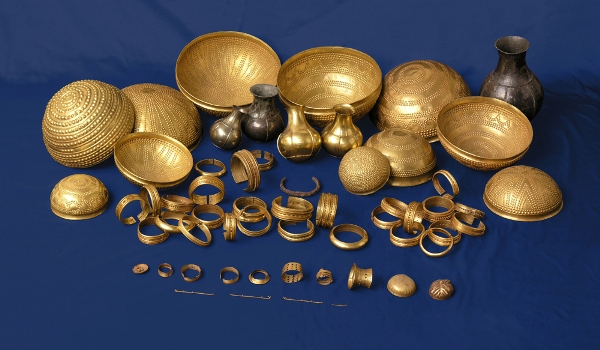
El tesoro del joyero / The goldsmith's treasure


El tesoro de Villena es uno de los conjuntos más importantes de la Edad del Bronce europea. Fue encontrado en 1963 por unos albañiles. Un joyero avisó en dos ocasiones al arqueólogo José María Soler porque vecinos trataron de tasar algunas piezas del tesoro. Poco después se descubrió en el lugar de las obras (la rambla del Panadero) una vasija argárica repleta de piezas de oro macizo y se pusieron bajo custodio de un juez para evitar robos. 59 vasijas y joyas en oro, plata, hierro (entonces considerado un metal precioso) y ámbar. Un tesoro solo superado por las Tumbas Reales de Micenas.

Según los expertos, el tesoro fue enterrado de manera precipitada, probablemente, para evitar que fuese encontrado en un ataque. Las teorías sobre su origen pasan porque fuese el patrimonio heredado durante generaciones de una familia dominante de la ciudad, y porque fuese el trabajo de un orfebre que escondió el encargo que le debía haber hecho algún reyezuelo inmensamente rico.

La piezas guardan similitudes con otras de otro tesorillo cercano, con piezas cerámicas de Orihuela y con otros objetos de yacimientos portugueses. En 2005, la colección arqueológica fue declarada Bien de Interés Cultural.

Facebook


---------------------------------------------------------------------------------------------------------------------------------------------------------------
The treasure of Villena (Alicante) is one of the most important European Bronze Age ensemble. It was found in 1963 by a bricklayers. A jeweller warned twice the archaeologist José María Soler because several neighbors tried to value many pieces of it. Shortly after, an Argaric pot was discovered in a building area (la rambla del Panadero), full of solid golden objects, and was taken into judicial custody to prevent theft. 59 vessels and jewels made of gold, silver, amber and iron (then, this metal was considered a precious metal). A treasure surpassed only by the Royal Graves of Mycenae.

According to experts, the treasure was buried hastily, probably, to avoid that was found in an foreign attack. The theories about its origin involves it was the patrimony inherited along generations by a powerful family of the city, or, on the other hand, it was the job of a goldsmith that hid the order of a immensely rich kinglet.

The pieces have similarities with another of a close treasure, with ceramic pieces found in Orihuela and another objects of many Portuguese sites. In 2005, the archaeological collection was declared Property of Cultural Interest.

@enriquevdiez
Facebook
My English is not very good. I'm trying to improve it. If you find any errors in the text, please write to me (enriquevdiez@gmail.com). Thank you very much.
viernes, 2 de enero de 2015

Ciencias españolas (I): Inventos / Spanish sciences (I): Invents

 
Ictíneo de Narciso Monturiol. Museu Marítim de Barcelona.

La leyenda negra española ha provocado que, durante siglos, se considere a la ciencia española como atrasada y falta de inventiva. En esta serie de artículos, trataré de hacer una introducción histórica de algunas aportaciones españolas a la Humanidad.

Los antecedentes de las patentes modernas fueron los privilegios de invención implantados en el siglo XV (el primero se creó en Florencia en 1421; el segundo en Venecia, en 1474; y el tercero en Castilla, en 1479). El primer privilegio hallado en un archivo español fue el concedido en Sevilla a Pedro Azlor por su sistema de molienda de harina. La reina Isabel la Católica protegió el invento en todos sus reinos por 20 años para que solo el inventor designase quién podía utilizarlo. En 1522, estos privilegios se convirtieron en reales cédulas. En 1679, en plena decadencia política, militar y socioeconómica, Juan José de Austria creó la Real Junta General de Comercio, dentro de su política reformista, para promover, desde tesis mercantilistas, las instituciones educativas y la protección de artistas, fabricantes y comerciantes. En 1788 se fundó el Real Gabinete de Máquinas del Buen Retiro, primera institución española destinada a la recopilación de información tecnológica y su difusión. La primera ley de patentes la decretó José I Bonaparte en 1811 y las Cortes de Cádiz regularon en 1812 la propiedad industrial. Estas instituciones evolucionarían hasta la actual Oficina Española de Patentes y Marcas. En este primer artículo, me centraré en algunas invenciones.

Manuscrito de Jerónimo de Ayanz con la explicación de la máquina de vapor.

 - La máquina de vapor moderna y el barco de vapor. Aunque la máquina de vapor fue inventada Herón de Alejandría en al antigüedad y hubo usos medievales como el del órgano a vapor de la catedral de Reims, la primera máquina de vapor moderna como tal fue inventada y patentada por Jerónimo de Ayanz en 1606. Su ingenio fue aplicado para achicar agua en la mina sevillana de Guadalcanal, donde aplicó otro invento: el aire acondicionado. El primer modelo de barco de vapor fue inventado por Blasco de Garay en 1543. Probó su invento en el puerto de Barcelona, aunque no contó con la financiación suficiente para producirlo en serie.


- El galeón, la fragata y el destructor. Si la carabela fue un invento portugués, el galeón fue creado en el siglo XVI en España para responder a las necesidades transoceánicas imperiales, aunque su polivalencia la convirtió en un navío clave para naciones con poca tradición naval, lo que contribuyó a su internacionalización. En el caso de la fragata, aunque la primera producción se debe a los holandeses, las primeras naves denominadas de esta manera fueron las utilizadas por los corsarios españoles en la Guerra de los Ochenta Años contra los rebeldes. Por último, el destructor fue diseñado por Fernando Villamil en 1885 (cuatro años de la construcción del navío japonés 'Kotake', tradicionalmente considerado primer navío de este tipo) y construido en los astilleros ingleses de James and George Thompson para luchar contra los buques torpederos.

 Plano del Garcibuzo de Cosme García Sáez.

- El vehículo submarino. Los sumergibles habían sido probados en la Edad Moderna por unos griegos en la corte de Carlos I en 1562 y por Ayanz en 1600. Sin embargo, los primeros vehículos submarinos fueron el Garcibuzo de Cosme García Sáez en 1859 (hundido por su creador al no encontrar financiación), los Ictíneos de combustión interna de Narciso Monturiol en 1864 y el submarino eléctrico de Isaac Peral en 1888 (no superado hasta la creación del submarino nuclear de USS Nautilus).

 Herrera trabaja en el primer traje espacial. Nationaal Archief
- El traje de astronauta. El ingeniero granadino Emilio Herrera, presidente del Gobierno republicano en el exilio, inventó la escafandra estratonáutica en 1935, el primer traje diseñado para el viaje espacial, modelo que copiaría la NASA 20 años más tarde.

 Autogiro Cierva C-30.

- El paracaídas y el autogiro. El sabio andalusí Abbás Ibn Firnás fue el primer hombre de la historia que realizó intentos científicos de volar. En el año 852 se lanzó desde una torre de Córdoba sujeto a una enorme lona para amortiguar la caída, convirtiéndose en el precursor del paracaídas. Años después voló unas decenas de segundos con unas alas de madera, seda y plumas. El autogiro fue diseñado por Juan de la Cierva en 1923. Introdujo posteriormente mando directo sobre el rotor y obteniendo, mediante un prelanzador (que había sido probado previamente por Heraclio Alfaro Fournier), un despegue casi vertical. Aunque con notables diferencias, este invento fue una alternativa al helicóptero creado por el argentino Raúl Pateras de Pescara, al igual que la libélula española ideada por Federico Cantero.

Aritmómetro electromecánico de Leonardo Torres Quevedo.

- El radiocontrol, la inteligencia artificial, el videojuego, el ordenador y el libro electrónico. Leonardo Torres Quevedo inventó y patentó antes que Nikola Tesla (que se le había adelantado en 5 años en el descubrimiento de la radio) el telekino, o primera máquina de radiocontrol del mundo en 1903. Con ella, controlaba a un autómata mediante ondas hertzianas (posteriormente, Matías Balsera inventaría el sistema de sintonización y codificación de frecuencias). A finales de 1913, presentó 'el ajedrecista', primera manifestación de inteligencia artificial y del primer videojuego de la historia. Se trataba de otro autómata con el que podía jugarse un final de partida de ajedrez. Por último, fue el pionero del ordenador moderno al presentar en 1920 (ya lo había ideado teóricamente años antes en sus 'Ensayos') un aritmómetro electromecánico que poseía las unidades que constituyen cualquier computadora: unidad aritmética, unidad de control, memoria, y órgano de salida e impresión de datos. El primer libro electrónico fue creado por la maestra Ángela Ruiz Robles en 1949 con la idea de aligerar el peso de la cartera de los niños.


- La falcata y el arcabuz. El arma más mortífera de la antigüedad fue incorporada y adaptada a la impedimenta de la tropa romana después de que los íberos hiciesen una carnicería con sus falcatas en la batalla de Cannas. En cuanto al arcabuz, aún está en discusión si fue descubierto por españoles, húngaros o alemanes. No obstante, fue un invento que revolucionó el arte de la guerra junto al cañón y la pica en la Edad Moderna.

Otros inventos destacados: el tren talgo, el sistema submarino de reciclaje de aire, el aparato portátil de rayos X, el modelo con escaleras de Valturio, la guitarra, el laúd, el cigarrillo, la fregona, el chupachups, el forceps, el laringoscopio, los quevedos, el futbolín, el puente transbordador, el torquetum, el cabestrante, la jeringuilla desechable, la navaja, la grapadora, el afilalápices eléctrico, el barociclonómetro, el nefoscopio, el microsismógrafo, la llave de miquelete, el sillón ergonómico, el astrolabio de al-Sahlî, la máquina de ejercicios gimnásticos, la mesa plegable, el botijo...

Facebook
----------------------------------------------------------------------------------------------------------------------
 
Narciso Monturiol Ictíneo. Museu Marítim de Barcelona.


The Spanish Black Legend has caused that, during centuries, Spanish Science has been considered backward and lack of inventiveness. In this post series, I'm going to try a historical introduction to several Spanish contribution to mankind.

The ancestors of modern patents were the invention privileges, set up in XV century (first in Florence in 1421; second in Venice, in 1474; third in Castile, in 1479). The first privilege found in a Spanish archive was a flour windmill invented by Pedro Azlor. Queen Isabella I protected the invention during 20 years allowing that only the inventor should designate who could use it. In 1522, these privileges became royal documents. In 1679, in the middle of a political, military, socioeconomic decline, Juan José de Austria created the Real Junta General de Comercio (General Trading Royal Committee), inside his reforming mercantilist policy, to promote the educational institutions and the protection of artists, manufacturers and businessmen. In 1788, the Real Gabinete de Máquinas del Buen Retiro (Buen Retiro's Royal Machine Office) was founded. It was the first Spanish institution destinated to gather together the technological information and its dissemination. The first patent law was ordered by Joseph I Bonaparte in 1811 and the Court of Cadiz regulated the industrial property. These institutions evolved until the current Oficina Española de Patentes y Marcas (Spanish Office of Patents and Trademarks). In this first post, I'm going to write about many inventions.

Jerónimo de Ayanz manuscript with the explanation about his steam engine. 

- The modern steam engine and the steamboat. Despite the steam engine was invented in the Ancient Age by Hero of Alexandria and there were medieval uses, as in the steam organ of the cathedral of Rheims, the first modern steam engine was invented and patented by Jerónimo de Ayanz in 1606. His devices were used to bale out water from the mine of Guadalcanal (Seville), where made use of another invention: the air conditioning. The first steamboat model was developed by Blasco de Garay in 1543. He checked his discovery in Barcelona's harbour. Nevertheless, he couldn't find enough funding to go into series production.


- The galleon, the frigate and the destroyer. While the carabel was a Portuguese invention, the galleon was created in XVI century in Spain to answer to the imperial transoceanic needs, although its versatility make it into a key ship to the nations which had a poor naval tradition, that contributed to its internationalization. In the case of the frigate, despite the first mass production was Dutch, the first models were used by Spanish privateers in the Eighty Years' War against rebels. Lastly, the destroyer was designed by Fernando Villamil in 1885 (four years before the development of the Japanese ship 'Kotake', traditionally considered the first vessel of this type) and made in James & George Thompson's shipyard to fight against torpedo boats.

Drawing of the Cosme García Sáez Garcibuzo.

- The submarine. The first waterproof vehicles were tested by Greek engineers in Charles V court in 1562 and, later, by Ayanz in 1600. Nevertheless, the first submarines were Cosme García Sáez 'Garcibuzo' in 1859 (sunk by its creator because of the lack of funding), Narciso Monturiol internal combustion submarine 'Ictineus' in 1864, and Isaac Peral electrical submarine in 1888 (whose model would stand until the development of the nuclear submarine USS Nautilus).

Herrera working in his spacesuit. Nationaal Archief.


- The space suit. The engineer from Granada Emilio Herrera, president of the Republican Government in the exile, invented the stratonautical suit in 1935, the first costume designed to the space travel, model that would be copied by NASA 20 years later.

 Autogiro Cierva C-30.

- The parachute and the autogiro. The Andalusian wiseman Abbas Ibn Firnas was the first man in history who made scientific attempts to fly. In 852, he leaped on from a tower of Cordoba fastened to a huge canvas to cushion the fall, becoming the forefather of the parachute. Several years later, he flied many seconds with a wings made of wood, silk and feathers. The autogiro was designed by Juan de la Cierva in 1923. He made later many improvements in the machine as a direct control over the rotor or obtaining, by a prethrower (that had been invented before by Heraclio Alfaro Fournier), an almost vertical takeoff. Despite the significant differences, this invent was an alternative of the helicopter, created by the Argentinian Raúl Pateras de Pescara, as the Spanish 'Dragonfly', conceived by Federico Cantero.

Leonardo Torres Quevedo electromechanical arithmometer.


- The radio control, the artificial intelligence, the videogame, the computer and the electronic book. Leonardo Torres Quevedo invented and patented before Nikola Tesla (who had discovered the radio five years before him) the 'telekino', that was the first radio control machine over the world in 1903. It allowed him to control an automaton by hertzian waves (subsequently, Matías Balsera would invent the tuning and coding frequency system). At the end of 1913, he presented 'The Chess Player', first device made with artificial intelligence and the first videogame. It was another robot who can play the end of a chess game. Finally, he was the pioneer of the current computer when he presented in 1920 (he had already conceived it years before in his 'Ensayos') his electromechanical arithmometer. It had the units of any computer: arithmetic unit, control unit, memory, exit unit and data printing. The first electronic book was created in 1949 by Ángela Ruiz Robles, a teacher who tried to make lighter the weight of children school bags.


- The falcata and the arquebus. The most lethal ancient weapon was incorporated and adapted to Roman Army 'impedimenta' after Iberians doing a slaughter with their 'falcatas' a slaughter on them in the battle of Cannae. Experts still discuss if arquebus was discovered by Spaniards, Hungarians or Germans. However, it was an invent that shook up the art of war in the Modern Ages together with cannon and the pike.

Another renowned invents: the talgo train, the submarine recycling air system, the X ray portable machine, the Valturius' stairway model, the guitar, the lute, the cigarette, the mop, the lollipop, the forceps, the laringoscope, the quevedos glasses, the table football, the ferry bridge, the torquetum, the capstan, the disposable syringe, the razor, the stapler, the electrical pencil sharpener, the barocyclonometor, the nephoscope, the microseismometer, the Miquelet lock, the ergonomic chair, al-Sahlî's astrolab, the gym machine, the folding table, the earthenware pitcher...

@enriquevdiez
Facebook
My English is not very good. I'm trying to improve it. If you find any errors in the text, please write to me (enriquevdiez@gmail.com). Thank you very much.

sábado, 29 de noviembre de 2014

La Invencible irlandesa / The Irish Armada

Streedagh Strand. Ireland.com

Investigadores irlandeses y españoles estudian el paso de la Armada Invencible por Irlanda. Los problemas climáticos arrastraron a parte de la flota al Mar del Norte. Desde ese punto, tuvo que regresar rodeando las islas británicas por la costa occidental de esta isla a causa de los vientos. En el trayecto sufrieron numerosos desastres y hundimientos.

Según los estudios realizados, varios navíos españoles tuvieron que desembarcar en tierra irlandesa. Cientos de soldados y marinos fueron asaltados por los lugareños o murieron ahogados, ahorcados o masacrados por los ingleses incluso después de prometerles seguridad en caso de rendición (la masacre de los soldados de Álvaro de Luzón en el condado de Donegal cuando ya se habían rendido a los ingleses, la matanza de supervivientes por parte del mercenario McLaughlan en el condado de Mayo,  el asesinato de los náufragos del Nuestra Señora del Socorro en la bahía de Tralee, la ejecución de soldados en la ciudad de Galway, entre otros).

El superviviente más destacado fue el capitán Francisco de Cuéllar, que escapó a la muerte tras sobrevivir en el bosque y ser acogido junto a varios de los suyos, primero por un tal O'Rourke y luego por el señor de MacClancy. Los ingleses sitiaron el castillo de este último, situado en Rosclogher. Mientras el noble irlandés optó por huir a las montañas, los españoles defendieron la fortaleza y consiguieron aguantar hasta que el ejército inglés levantó el sitio a causa del mal tiempo. Posteriormente, el obispo de Derry ayudó a los españoles a partir hacia Escocia y, de allí, a las islas Hébridas. Seis meses después Cuéllar obtuvo un pasaje a Flandes expedido por el duque de Parma pero su barco volvió a naufragar. Ya en Holanda sufrió una experiencia similar a la vivida en Irlanda. Escribió sus vivencias en una extensa carta que es considerada un texto clave para conocer parte de la historia de ese país, ya que gran parte de los archivos históricos nacionales fueron destruidos siglos después.

El naufragio de la Armada Invencible llevó también a Irlanda dos leyendas. Se dice que la patata, tubérculo de procedencia americana, llegó a la isla en los galeones españoles, llegando a convertirse en el alimento más importante de la dieta irlandesa. Además, otra leyenda habla de que los 'black irish' proceden de la mezcla de las nativas con los españoles que sobrevivieron a la tragedia y se quedaron en Irlanda.

Carta de Francisco de Cuéllar
Facebook
--------------------------------------------------------------------------------------------------------------------------
Streedagh Strand. Ireland.com

Over the years, Irish and Spanish researchers study the trace of the Spanish Armada around Ireland. Climatic problems swept a part of the fleet to the North Sea. From there, it had to go around the British Islands by the west coast of Ireland because of strong winds. In the course of its travels, it suffered several shipwrecks and disasters.

According to the studies, many Spanish crews had to disembark their ships in Irish lands. Hundreds of sailors and soldiers were robbed by locals or died drowned or hanged, or otherwise slaughtered by Englishmen, even after the promise of security if they surrendered (i.e. the massacre of the soldiers commanded by Álvaro de Luzón in County Donegal, the slaughter of Spanish survivors by captain McLaughlan in County Mayo, the surrendered crew of Nuestra Señora del Socorro in the bay of Tralee, survivors executed in the city of Galway, among others).

The most famous survivor were the captain Francisco de Cuéllar, who escaped after having hidden in a forest and then being welcomed with several of his colleagues by the O'Rourke's and, later, by lord MacClancy. Englishmen sieged MacClancy's castle, placed in the town of Rosclogher (County Leitrim). While the Irish nobleman ran away to the mountains, the Spaniards defended the fortress and hung in there until the English army lift the siege because of the bad weather. Afterwards, the bishop of Derry, Redmond O'Gallagher, helped Spaniards to go to Scotland and, from there, to the Hebrides. Six months later Cuéllar got a letter of safe conduct from the Duke of Parma to Flanders but his ship was shipwrecked again. Once in Holland, Cuéllar suffered a similar fate as in Ireland. He wrote his experience in a long letter that is considered a key text to understanding this portion of Irish history because of many of their national archives were destroyed centuries after.

The Spanish Armada shipwrecks contributed two legends to Irish lore. It has been said that the potato, a South American tuber (brought back to Europe by XVI century Spanish explorers), arrived in Ireland by the way of Spanish galleons, quickly becoming the most important staple of the Irish diet. Another legend describes how the 'Black Irish' people emerged from the unions of Irish women with the Spanish survivors of the Armada.

Letter of Francisco de Cuéllar (English version)
@enriquevdiez
Facebook
My English is not very good. I'm trying to improve it. If you find any errors in the text, please write to me (enriquevdiez@gmail.com). Thank you very much.

viernes, 5 de septiembre de 2014

El desastre cubano / The Cuban disaster


Coincidí en la carrera con una tataranieta del almirante Cervera. Me explicó la humillación pública que sufrió su ancestro por desarrollar una estrategia conservadora en la guerra de Cuba ante Estados Unidos.

El conflicto se había producido, en pleno movimiento independentista cubano, como resultado del colonialismo estadounidense que, aplicando la doctrina Monroe -'América para los americanos'... del norte- que vio en esta guerra una ocasión perfecta para abrirse camino como primera potencia militar mundial.

La voladura del acorazado 'Maine', probablemente debida a una ignición interior (está por demostrar si fue una explosión intencionada americana o un accidente, ya que la tesis de la voladura a causa de una mina española está prácticamente descartada), aderezada con la propaganda de Hearst, fue el argumento perfecto para una guerra que guarda importantes similitudes con el conflicto hispano-alemán por las islas Carolinas: un país decadente que trataba de defender a toda costa su imperio colonial ante una potencia en ascenso, a pesar de que no contaba con la infraestructura militar ni el poderío económico para mantenerlo. A cambio, la cúpula política y militar española inducía a la población a creer en las hazañas bélicas imposibles para esconder la profunda crisis de país que sufría España en lo político, lo social, lo económico, lo tecnológico y lo espiritual.

En concreto, el episodio de Cervera se produjo en la bahía de Santiago de Cuba. Estados Unidos bloqueó el puerto después de destrozar la flota española en Cavite (Filipinas). Cervera optó por una estrategia conservadora y atrincheró sus naves en el puerto mientras los acorazados estadounidenses esperaban en el exterior, ya que sabía que en mar abierto la flota americana era por entonces claramente superior. Rehusó realizar operaciones relámpago para obligar a replegarse a los estadounidenses. La presión política y militar sobre Cervera fue brutal. Fue tildado de cobarde, a pesar de la misión suicida que le habían encomendado.

Los americanos desembarcaron en Cuba y sufrieron profundamente para avanzar por tierra hasta la capital. Entonces, se produjo el desastre. Cervera recibió la orden de salir de su reclusión para evitar la captura de los barcos, ante la inminente toma de la ciudad. Su estrategia de batalla resultó fatal para la flota española. Los anticuados barcos españoles salieron uno a uno del puerto y fueron cañoneados fácilmente por los americanos, que hundieron la flota, mataron a 371 personas y tomaron 1.670 prisioneros.

Tras la derrota, el Gobierno español juzgó a Cervera por el desastre, tratando de responsabilizarlo. Sin embargo, el clamor popular y numerosos políticos e intelectuales, dentro y fuera del país, se pusieron a su favor. Finalmente, su causa fue sobreseída.

@enriquevdiez
Facebook
------------------------------------------------------------------------------------------------------------

I studied at my university with an Admiral Cervera's great-great granddaughter. She explained to me the public humiliation to which her ancestor was subjected, because of his conservative naval strategy against USA in the Spanish-American War.

The conflict occured in the middle of the Cuban Independence. As a result of the US colonialism, and making use of the Monroe Doctrine ('America for the -North- Americans') this country used the conflict as the perfect occasion to establish itself as a worldwide military power.

The sinking of cruiser USS Maine, probably due to an internal ignition (the cause of the explosion is still to be proven: an American deliberate explosion or an accident, because of the Spanish mine theory is almost discarded), fanned by Hearst propaganda, provided the perfect excuse for this war, which had surprising similarities with the conflict of the Caroline Islands between Spain and Germany: a country in decline trying to defend its colonial empire at all costs against an ascending power without the military, administrative and economic infrastructure to establish their own. However, the Spanish political and military leadership encouraged nation to believe in victory and impossible great feats to cover its deep political, social, economic, technological and spiritual crisis.

In particular, Cervera's episode happened in the bay of Santiago de Cuba. United States blockaded the port after destroying the Spanish fleet in Cavite (Philippines). The Spanish admiral chose a conservative strategy and entrenched his fleet in the harbour while the American battleships waited outside, because he knew that American fleet was then clearly superior in open sea. He denied to make hit-and-run operations in an attempt to force US fleet to withdraw. The political and military pressure on and toward Cervera was brutal. He was described as a coward, despite the task he had been given was a suicide mission.

Americans disembarked in Cuba and suffered a lot during its advance towards the capital. Then, the disaster struck. Cervera received instructions to remove his fleet from the confinement to avoid capture of the ships, before the imminent fall of the city. The battle strategy proved fatal to the Spanish squadron. The obsolete Spanish ships left one-by-one from the port and were easily bombarded by the Americans, that sank the fleet, killed 371 people and took 1.670 prisoners.

After his return to Spain, the Spanish government convened a trial of Cervera for the loss of his command. Although the government sought to blame Cervera, public opinion, his staff, and several politicians and intellectuals, both inside and outside the country, supported him. At last, his lawsuit was dismissed.

@enriquevdiez
Facebook
My English is not very good. I'm trying to improve it. If you find any errors in the text, please write to me (enriquevdiez@gmail.com). Thank you very much.

viernes, 22 de agosto de 2014

72 días en Brunei / 72 days at Brunei

Fuente: Sitbatan

Hubo dos meses en que Brunei fue tierra española. En 1578, el imperio de Felipe II y el sultanato de Brunei entraron en guerra por razones religiosas y geoestratégicas.

Cuando el 8 de julio de 1521 Fernando de Magallanes pisó la isla de Borneo, el sur de Filipinas era un satélite político de Brunei a través del Islam. Este estado borneano era la gran potencia regional. Dominaba la mitad de la isla en que hoy se asienta este pequeño estado petrolífero, así como zonas malayas, y mantenía una importante influencia sobre Indonesia.

España conquistó la isla de Cebú en 1565 y comenzó a cristianizar la zona, algo que fue mal visto por el sultanato. En 1571, Miguel López de Legazpi fundó Intramuros (el germen de la moderna ciudad de Manila) y la convirtió en la capital de las Indias Orientales Españolas. Los conquistadores no fueron bien recibidos. Y así, tres años después, hubo revueltas locales que contaron con apoyo de Brunei y que fueron sofocadas.

Ese mismo año, el gobernador español, Francisco de Sande, por orden de Felipe II, envió una misión diplomática al sultán de Brunei Saiful Rijal para mejorar las relaciones entre ambos estados, pedir permiso para difundir el cristianismo en Filipinas y exigir cesar de islamizar el nuevo territorio español. El sultán se opuso a la propuesta religiosa y exigió permitir la expansión del Islam en Filipinas, denegó la recaudación de impuestos religiosos cristianos y prohibió la evangelización en Borneo.

España derrotó al pirata chino Limahon en Pangasinan en 1575, estableció relaciones diplomáticas con China (a pesar de la fallida expedición de Martín de Rada para crear en Fujian una colonia parecida a la que tenían los portugueses en Macao) y se asentó definitivamente como la nueva potencia del ámbito. Por último, declaró la guerra a Brunei en 1578, con el argumento de las negativas de Rijai. De Sande ofreció al sultanato convertirse en un protectorado imperial, a cambio de poner en el trono a un hermano del sultán, Pengiran Seri Lela. Al negarse, una pequeña flota cargada con 400 soldados españoles, acompañados por varias divisiones de arqueros filipinos y borneanos, venció primero a una flota de Borneo, y luego atacó y capturó en dos días la capital, Kota Batu.

Así, el 16 de abril de 1578, la ciudad estaba controlada por los españoles. El sultán huyó a Jerudong. Los españoles sufrieron epidemias de cólera o disentería y decidieron abandonar la ciudad el 26 de junio, al no poder establecer una base adecuada. Antes de irse, quemaron la mezquita. El aspirante al trono cayó derrotado por el sultán y regresó a pedir ayuda a los españoles. Estos reconquistaron la isla y, cuando volvieron a Manila por falta de suministros, su aspirante volvió a perder el poder por su actitud cobarde. En la tercera ocasión, los españoles no ayudaron a Seri Lela, que fue asesinado por su hermano.

Rijal no quiso tener contacto con una nación que le había derrocado dos veces. Por esta razón, hubo que esperar hasta 1599, muerto ya el sultán, para que se recuperaran las relaciones comerciales y diplomáticas.

Este incidente está considerado por algunas personas en Brunei como una suerte de épica guerra de independencia. En realidad, aparte del asunto religioso, lo que se disputó fue el eje de gravedad geopolítica en esa zona del sudeste asiático que pasó a manos españolas a medida que Filipinas se convirtió en la correa de transmisión de América y Europa con Asia oriental.

@enriquevdiez
Facebook
------------------------------------------------------------------------------------------------------------
Font: Sitbatan

There was two months in which Brunei was a Spanish territory. In 1578, the Empire of Philip II and the Sultanate of Brunei went to war for religious and geostrategic reasons.

When 8 July 1521 Ferdinand Magellan set foot onto the island of Borneo, South Philippines was a Brunei's satellite by Islam. This historical Bornean state was the most important regional power of the period. It dominated half of the island where this small oil state is currently established, as well as current Malaysian territories. It also had an important influence over Indonesia.

Spain conquered the island of Cebu in 1565 and started to Christianize the zone. It was seen in a bad light by the Sultanate. In 1571, Miguel López de Legazpi, founded Intramuros (the seed of the modern city of Manila) and transformed it in the capital of the Spanish Eastern Indias. The conquerors weren't welcomed. Three years later, there was a local uprising with Bruneian support that were suppressed.

In the same year, the Spanish governor, Francisco de Sande, by order of Philip II, sent a diplomatic mission to the sultan of Brunei Saiful Rijal to improve the relations between both states, to ask for permission to spread Christianism in Philippines and to require the cessation of Islamization of the new Spanish territory. The sultan disagreed with the religious proposal and demanded to let the Islamic expansion in Philippines, refused the Spanish religious taxes and forbade the evangelization in Borneo.

Spain defeated the Chinese pirate Limahong in Pangasinan in 1575, established diplomatic relations with China (despite the unsuccessful expedition of Martín de Rada to creat in Fujian a colony as the Portuguese one in Macau) and set up permanently as a new power in the region. Lastly, it declared war to Brunei in 1578, arguing Rijal's refusal. De Sande offered to make the Sultanate as an imperial protectorate, in exchange for putting a sultan's brother, Pengiran Seri Lela, on the throne. By refusing these conditions, a small fleet with 400 Spanish soldiers, accompanied by several Filipino archers and Borneans, vanquished the sultan's fleet and later attacked and captured in two days the capital, Kota Batu.

Thus, 16 April 1578, the city was under Spanish control. The sultan fled to Jerudong. Spaniards suffered a epidemic disease of cholera or dysentery, and decided to abandon the city on June 26, unable to establish a proper base. They burnt the mosque before leaving. The throne's challenger was defeated by sultan and returned to ask for Spanish help. They reconquered the island and, when the soldiers went back to Manila because of the lack of supplies, the contender lost cowardly the power again. In the third chance, Spaniards didn't help Seri Lela, that was murdered by his brother.

Rijal didn't want to have contact with a nation which had overthrew him twice. For this reason, it was not until 1599, after sultan's death, to recover the diplomatic and commercial relations.

This incident is considered for some Bruneian people as a sort of epic independence war. In fact, aside the religious matter, the geopolitical power in this South East Asian region was the cause of the conflict. It shifted into Spanish hands as Philippines became the transmission belt between America and Europe with East Asia.

@enriquevdiez
Facebook
My English is not very good. I'm trying to improve it. If you find any errors in the text, please write to me (enriquevdiez@gmail.com). Thank you very much.