Mostrando entradas con la etiqueta Medieval. Mostrar todas las entradas

viernes, 9 de diciembre de 2016

El escudo partido / The divided blazon

Escudo de armas de Castilla y León.

La heráldica es una ciencia auxiliar de la historia que analiza los escudos de armas de los linajes, las ciudades y las personas. Cada elemento, cada color y cada forma incluida en un blasón representan hechos políticos e históricos básicos para entender dichos símbolos.

La principal aportación española a la heráldica quizás fue la de Fernando III, apodado 'el Santo'. En 1230, cuando el castellano adquirió la Corona de León (gracias a la prudente concordia de Benavente firmada por su madre, Berenguela, y sus medio hermanas, Sancha y Dulce) y unificó definitivamente el reino de su padre Alfonso IX con la corona de Castilla, decidió revolucionar su blasón. Dividió el escudo en cuarteles en cruz en los que incluyó por igual la enseña de Castilla y la de León, reflejando así la unión indivisible de ambos reinos. Fernando colocó, eso sí, el escudo de su madre -Castilla- por delante del de su padre -León-, contraviniendo la tradición heráldica, que da prioridad al linaje paterno.

Escudo de armas del reino de Sicilia.

La idea funcionó tan bien que fue copiada en toda Europa. De hecho, dio pie a la siguiente innovación: el cuartelado en aspa o sotuer, que surgió en la Corona de Aragón. Pedro III 'el Grande' de Aragón y Constanza II de Sicilia repartieron en su testamento sus territorios entre sus hijos. Al primogénito, Alfonso, le correspondieron Aragón y Valencia. A Jaime le tocó Sicilia. Los otros dos hermanos, Federico y Pedro no obtuvieron título real, pero tenían derecho a tener su propio escudo de armas. Para diferenciarlos de los anteriores, se diseñó un escudo con cuarteles divididos en aspa. Cuando Jaime se avino a ceder la corona de Sicilia a su hermano Federico, tras la paz de Caltabellota de 1302, el nuevo monarca mantuvo el formato en aspa de su escudo, incluyendo la enseña del linaje de los Hohenstaufen, convirtiéndose en la enseña de ese estado hasta la creación del reino de las Dos Sicilias, en 1816.

--------------------------------------------------------------------------------------------------------------------------
Coat of arms of Castile and León.

Heraldry is an auxiliary science for History that analyses the coat of arms of lineages, cities and people. Each element, each colour and each shape included in a blazon represent political and historical basic facts to understand such signs.

Ferdinand III 'The Saint' developed the main Spanish contribution to heraldry. In 1230 a.C., when this Castilian king got the Crown of León (thanks to the cautious Benavente's concord signed between Ferdinand's mother, Berengaria, and his half-sisters, Sancha and Dulce). The new Castile and León king divided the coat of arms in quarters with a cross. In those quarters included equally the ensigns of Castile and León, showing the indivisible union of both kingdoms. However, Ferdinand put his mother's banner -Castile- ahead his father's -León-, contravening the heraldic custom, that gives precedence to paternal lineage.

Coat of arms of the kingdom of Sicily.

The idea worked so well that was copied across Europe. In fact, caused another innovation: the shield quartered in vane or sotuer, that was developed in the Crown of Aragon. Peter III 'the Great' of Aragon and Constance II of Sicily distributed their territories in their testament between their sons. The firstborn, Alfonso, got Aragon and Valencia. James received Sicily. The youngest brothers, Frederick and Peter did not obtain royal title, but they had the right to have their own coat of arms. To differentiate them from their elder brothers, it was designed a banner with quarters in vane. When James agreed to give up the Crown of Sicily to his brother Frederick, after the peace of Caltabellota -1302 a.C.-, the new king kept the format, including the ensign of the Hohenstaufen's lineage, becoming the pennant of that state until the creation of the kingdom of the Two Sicilies, in 1816.

My English is not very good. I'm trying to improve it. If you find any errors in the text, please write to me (enriquevdiez@gmail.com). Thank you very much.

martes, 9 de junio de 2015

La droga de Wamba / Wamba's drug


Los reyes visigodos no tuvieron nada que envidiar a 'Juego de Tronos' en sus maniobras políticas... y sin necesidad de dragones. Uno de los ejemplos más claros fue el del destronamiento del rey Wamba. Este anciano noble fue nombrado rey en Gérticos y coronado en Toledo tras la muerte de Recesvinto en el año 672 d.C., a pesar de que inicialmente rechazó el cargo. Rindió a los vascones y frenó una invasión sarracena por el Estrecho de Gibraltar (preludio de la que ocurriría en 711 d.C.). También sofocó la grave sublevación de la Septimania liderada por Ilderico y la usurpación en Narbona del duque Paulo, que se autoproclamó rey en Gerona con la corona de Recaredo. Impuso una ley militar ante la falta de ayuda de la nobleza en el conflicto, obligándoles a aportar tropas al ejército del reino. Por otra parte, trató de rearmar moralmente a la sociedad hispanovisigoda a través de varios concilios (XI de Toledo y III de Braga) e intentó controlar la gestión de los recursos eclesiásticos que hacía el alto clero.

La aristocracia buscó la manera de acabar con él. La conjura, encabezada por su sucesor Ervigio, ocurrió así: dieron a beber al rey una droga (según la Crónica de Alfonso III, una fuerte dosis de esparteína) que le hizo sentir cercano a la muerte. Éste pidió hacer penitencia, realizada por Julián de Toledo. Conforme a la costumbre de la época para los moribundos, fue tonsurado y vestido con el hábito de penitente. Esto le incapacitaba legalmente para reinar (la ley no permitía reinar a una persona que hubiese vestido los hábitos). El monarca quedó dormido y, cuando despertó, tuvo que renunciar a su cargo. Se retiró al monasterio de San Vicente de Pampliega, donde murió en 688. Mientras tanto, el XII Concilio de Toledo, guiado por muchos de sus detractores, criticó duramente su reinado y desmanteló buena parte de sus políticas. Sus restos fueron trasladados a Toledo en el siglo XIII por orden de Alfonso X y, en la Guerra de la Independencia, su tumba y la de Recesvinto fueron profanadas por los soldados franceses.

Facebook
--------------------------------------------------------------------------------------------------------------------------

Visigothic kings does not take second place when compared to 'Game of Thrones'... without the need for dragons. One of the most obvious examples was king Wamba's dethronement. This old nobleman was designated in Gérticos and proclaimed in Toledo after Recceswinth's death in 672 a.C., despite his initial refusal. He defeated Basque army, prevented a Saracen invasion from strait of Gibraltar (a prelude of what was going to happen in 711 d.C.). Wamba also stifled Hilderic revolt in Septimania and duke Paul usurpation in Narbonne, self-proclaimed king in Girona with Reccared's crown. The monarch imposed a military law after the nobility lack of help in that conflict, forcing them to provide troops to the kingdom's army. On the other hand, he tried to rearm morally the Hispanic- Visigothic society by several councils and to manage clergy uses of the ecclesiastical resources.

Aristocracy sought a way to break up with him. The conspiracy, leaded by Erwig in Pampliega, happened 14 as follows: they gave him something to drink poisoned with a drug (according to Alfonso III Chronicle, a hard dose of sparteine) that made the king feel near to death. He asked for penance, made by Julian of Toledo (who participated in the plot). According to the custom with the dying men, Wamba was tonsured and dressed with a penitent habit. This action made him legally unable to rule the kingdom (the law impeded the reign of somebody who had worn religious habits). The king fell asleep and, when he woke up, he had to gave up its position. Wamba went away to a the monastery of Saint Vincent of Pampliega where he died in 688 a.C. Meanwhile, XII Council of Toledo, leaded by his detractors, strongly criticized Wamba's reign and broke up a large part of his politics. His body was moved to Toledo in XIII century by order of Alfonso X and, in the Spanish Independence War, his tomb and the Recceswinth one were profaned by French soldiers.

@enriquevdiez
Facebook
My English is not very good. I'm trying to improve it. If you find any errors in the text, please write to me (enriquevdiez@gmail.com). Thank you very much.

miércoles, 12 de noviembre de 2014

¿Reconqué? / Reconwhat?

Entrega de Granada. Francisco Pradilla. 1882.

Todos los colegios enseñan que los reinos cristianos medievales de la península ibérica 'reconquistaron' el territorio a los musulmanes. Sin embargo, esta afirmación, lejos de ser correcta, fue una construcción propagandística para sustentar las campañas de dichos reinos para hacerse con regiones tomadas por el Islam. Como dijo Ortega y Gasset: "Una reconquista de ocho siglos no es una reconquista".

El Islam conquistó la mayor parte de la península ibérica e impuso su dominio al resto en apenas tres décadas tras vencer en la batalla de Guadalete en el año 711 a los visigodos y acabar con su reino. Tras alrededor de tres siglos de vigor político, la presencia musulmana en la península entró en declive hasta su desaparición con la conquista del reino nazarí de Granada por los Reyes Católicos en 1492. Hay una rama de la historiografía que defiende que existe Reconquista desde el principio de la invasión musulmana ya que el mítico rey asturiano Pelayo venció a los musulmanes en una escaramuza en Covadonga en 722. Sin embargo, otra buena parte de los profesionales discute la importancia histórica de este hecho y pone de manifiesto que gran parte de la población hispanovisigoda se acomodó al nuevo gobierno centralizado que implantaron los sucesivos gobiernos islámicos.

Entonces, ¿de dónde viene la idea de la reconquista? El rey Leovigildo conquistó territorios cántabros, bastetanos, malagueños, aragenses, sabarios, suevos, bizantinos, cordobeses y orospedanos, antes de fundar la ciudad de Recópolis. El cronista Juan de Bíclaro se refirió a estas victorias en 578 como una reintegración de los dominios visigodos, a pesar de que fue una conquista de suelo ajeno. Y es que consideraban a Hispania como una unidad geográfica cuya soberanía les correspondía, después de que apenas 50 años antes los terratenientes hispanorromanos transfiriesen sus lealtades primero al rey Ataúlfo y, posteriormente, en mayor medida, a Eurico, al entender que el poder imperial romano solo se sostenía por el apoyo de los visigodos, que actuaban como pueblo federado de los romanos en Hispania y la Galia. Así, la monarquía hispanogoda se reconoció política y legalmente heredera y sucesora de Roma en la península. Suintila se autoproclamó 60 años después rey de las Spanias al lograr la unificación peninsular tras expulsar a los bizantinos. Este título fue utilizado indistintamente por gobernadores cristianos e islámicos ibéricos para tratar de imponer su hegemonía legal sobre el resto, a modo de emperador hispánico. De hecho, fue utilizado legalmente hasta la unificación del Estado por Felipe V mediante los decretos de Nueva Planta, promulgados a principios del siglo XVIII.

Los gobernantes de los diversos estados cristianos, descendientes del reino asturiano y de la Marca Hispánica franca, se consideraron a sí mismos a menudo como herederos legítimos y de sangre de los godos, mecanismo legal con el que justificaron sus políticas expansionistas hacia el sur musulmán. Por eso hablaron de reconquista, a pesar de que tomaban territorios en los que la mayoría social era tan hispana como ellos. A los reyes cristianos tardomedievales y de la Edad Moderna también les benefició mantener este concepto para reforzar algunos aspectos de su política religiosa y sus proyectos de unificación del Estado.

Facebook
--------------------------------------------------------------------------------------------------------------------------
The Capitulation of Granada. Francisco Pradilla. 1882.

All schools taught that the Iberian Christian medieval kingdoms 'reconquered' the peninsular territory to the Muslims. Nevertheless, this statement is far from being correct. It was a propaganda construction to hold those kingdoms' campaigns to get regions taken by Islam. As Ortega y Gasset said: "An eight century reconquest is not a reconquest".

Islam conquered  most of the Iberian peninsula and imposed its power in three decades after its victory against Visigoths in the battle of Guadalete in 711, ending its kingdom over Hispania. After three centuries of political vigour, Muslim presence in the peninsula went into decline until its dissapearance in the conquest of the Nasrid kingdom of Granada by the Catholic Monarchs in 1492. A branch of historiography defends that Reconquista exists from the beginning of the Muslim invasion because of the mythic Asturian king Pelagius defeated Muslims in Covadonga in 722. Nevertheless, another experts discuss the historical importance of this fact and shows that a large portion of Hispano Visigothic population adjusted to the new centralized government that was set up by consecutive Islamic government.

Then, where does the idea come? King Liuvigild conquered territories from Cantabria, Bastetania, Malaga, Orense (Aragense country), Sabaria, Suevi, Spanish Byzantium, Cordoba and Orospeda, before the foundation of Reccopolis. The chronicler Juan de Bíclaro alluded these victories in 578 as a return to the Visigothic possession, despite they were a conquest abroad. Visigoths considered Hispania as a geographic unit whose sovereign belonged themselves. Hispanic Roman landowners had transfered their loyalty to these Germanic people 50 years ago, in the person of king Ataulf, first, and king Eric, in a greater extent. They understood that Roman Imperial power was only maintained with the Visigothic support, that was acting as a federated people in Hispania and Gaul. Thus, the Hispanic Gothic monarchy recognized itself, politically and legally, as the Roman heir and successor in the peninsula. Suintila declared himself king of the Spanias 60 years after because of the peninsular unification after the expulsion of the Byzantine army. This title was used equally by Christian and Islamic Iberian governors with the intention of imposing their supremacy on the rest, as an Hispanic emperor. In fact, it was used legally until the unification of the Spanish State by Philip V by Nueva Planta decrees, published in the beginning of XVII century.

Governors of the different Christian states, descendants of the Asturian kingdom and the Frank Marca Hispanica, considered themselves often as legal and blood heirs of the Goths, as a lawful mechanism to justify their expansionist politics against the Muslim peninsular south. That is why they talked about reconquest, despite they captured territories where the social majority were as Spaniard as them. Late-medieval and Modern Christian kings benefited from maintain this concept to reinforce several aspects of their religious politics and their unification projects.

@enriquevdiez
Facebook
My English is not very good. I'm trying to improve it. If you find any errors in the text, please write to me (enriquevdiez@gmail.com). Thank you very much.

martes, 16 de septiembre de 2014

Himnos de España (I): El himno andalusí / Spanish hymns (I): The Andalusian hymn


Algunos musicólogos defienden que la obertura instrumental del movimiento Dary de la Nuba al-Istihlál es el origen del himno de España, aunque no hay estudios científicos que sustenten tal afirmación. Existen varias tesis sobre su origen. La más extendida es que esta pieza pertenece a la tradición musical andalusí de Marruecos. No obstante, hay expertos que defienden que la partitura es obra del filósofo de Saraqusta (Zaragoza) Ibn Bayyah (Avempace), que vivió en dicho reino de taifa entre los siglos XI y XII.


------------------------------------------------------------------------------------------------------------
Palace of the Aljafería (Zaragoza).

Many musicologists defend that the instrumental oberture of the movement Dary of the Nuba al-Istihlál is the origin of the Spanish hymn, although there are no scientific studies to base this assertion. There are several theories about its origin. The most common is that this piece belongs to the Moroccan Andalusian musical tradition. Nevertheless, there are experts who argue that the author of the original score is the phylosopher of Saraqusta (Zaragoza) Ibn Bâjja (Avempace) who lived in that taifa kingdom between XI and XII centuries.


@enriquevdiez
Facebook
My English is not very good. I'm trying to improve it. If you find any errors in the text, please write to me (enriquevdiez@gmail.com). Thank you very much.

lunes, 23 de junio de 2014

Sangre azul // Blue blood


Es común entre la nobleza española actual escuchar que la sangre azul se inventó en los reinos de la península ibérica en el siglo IX. La aristocracia creó este concepto para diferenciarse del resto de la población y probar su linaje cristiano y visigodo.

En un cutis blanco y fino, las venas se marcan con color azulado. Así, la palidez de la piel en el brazo que sostenía el arma indicaba que los privilegiados no realizaban trabajos físicos ni sufrían las inclemencias del tiempo como hacían los campesinos y artesanos. Además, era prueba de pureza cristiana, ya que demostraba, en plena Reconquista, que no tenían nada que ver con moros ni judíos.

Este argumento fue adoptado por todos los reinos de Europa y es la causa de que, en los cuentos infantiles, los príncipes sean azules, aunque su sangre sea igual de roja que la de cualquier ser humano.

@enriquevdiez
Facebook
------------------------------------------------------------------------------------------------------------

It's common to hear the current Spanish nobility that blue blood was invented in Iberian kingdoms in IX century. Aristocracy created this concept to differentiate themselves from the rest of the population and to demonstrate their Christian and Visigothic lineage.

In a white thin skin, veins are marked with a blue colour. The skin pallor in the arm which held the weapon denoted that privileged didn't do any physical work as peasants and artisans. Although, it was a Christian purity test because it showed that they had anything to do with Moors and Jews, in the middle of the Reconquista.

This argument was assimilated by all of the European kingdoms and is the cause of the blue princes (brave or charming princes, in the English culture) of the fairy tales, even though their blood is as red as another human beings.

@enriquevdiez
Facebook
My English is not very good. I'm trying to improve it. If you find any errors in the text, please write to me (enriquevdiez@gmail.com). Thank you very much.

martes, 18 de marzo de 2014

La venganza del conde don Julián / The revenge of count Julian


Cuenta una leyenda árabe que don Julián, conde de Ceuta, envió a su hija Florinda a Toledo para que fuese educada en la corte visigoda y encontrase marido. El rey Rodrigo sufría sarna y eligió a la joven para que se la limpiase con un alfiler de oro. El monarca la violó y ella mandó al padre varios regalos entre los que había un huevo podrido. Don Julián comprendió lo que había ocurrido. Fue a Toledo a reclamar a su hija con la excusa de que su mujer estaba muy enferma y solo la visión de Florinda la haría mejorar. Rodrigo le dio permiso. Cuando don Julián llegó a Ceuta, entabló conversaciones con Musa ibn Nusair para que desembarcase en la península ibérica. Fue el principio del fin de los visigodos.

Esta leyenda es la más común entre las numerosas que hablan de la caída del último rey visigodo. Los historiadores no se ponen de acuerdo sobre cuáles fueron las causas que permitieron la entrada de los musulmanes en la península ibérica. Al parecer, Rodrigo tomó violentamente el poder a la muerte de Witiza en el reino, aunque algunas fuentes señalan que Agila II también gobernaba en algunas zonas. La situación de guerra civil, de enfrentamiento de la aristocracia, el intervencionismo eclesiástico, la crisis agraria y las querellas dinásticas permitieron a un pequeño contingente musulmán asaltara con éxito el reino. La batalla de Guadalete y la toma de Toledo, en el año 711, fueron los hitos que abrieron la puerta peninsular al Islam.

@enriquevdiez
------------------------------------------------------------------------------------------------------------

According to an Arabian legend, Julian, count of Ceuta, sent his daughter Florinda to Toledo to be educated in the Visigothic court and found a husband. The king Roderic suffered scabies and chose the young woman to clean him with a golden pin. The monarch raped her and Florinda sent her father many presents, including a rotten egg. Julian understood what had happened. He went to Toledo to require his daughter with the excuse that his wife was very ill and only the vision of Florinda would be able to recover her. Roderic authorised them. When Julian arrived at Ceuta, he initiated exploratory talks with Musa ibn Nusair to allow him to disembark his troops in the Iberian peninsula. It was the beginning of the end of the Visigoths.

This legend is the most common among the stories about the fall of the last Visigothic king. Historians can't agree about which causes allowed Muslims to penetrate in the Iberian peninsula. It seems that Roderic took kingdom power violently after Wittiza's death, although some fonts note that Achila II ruled some areas. The civil war situation, the aristocratic confrontation, the ecclesiastical interventionism, the dynastic quarrels, and the agrarian crisis permitted a small Muslim army to assault the kingdom. The battle of Guadalete and the fall of Toledo, in 711 aC, were the milestones which opened the peninsular door to the Islam.

@enriquevdiez
My english is not very good. I'm trying to improve it. If you find any errors in the text, please write to me (enriquevdiez@gmail.com). Thank you very much.

miércoles, 19 de febrero de 2014

La ciudad resplandeciente/ The shining city

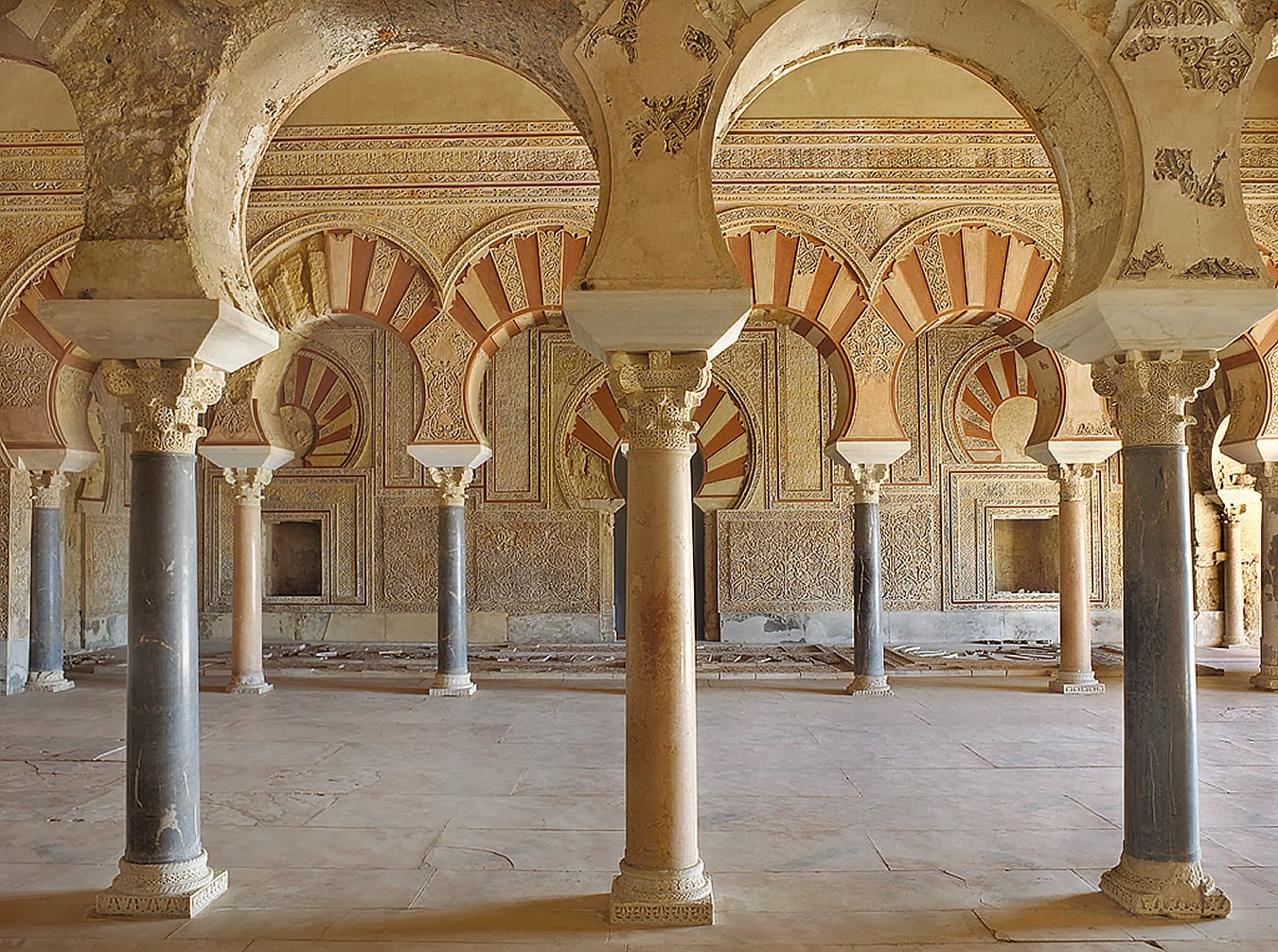
Salón de Abd al-Rahmán III. Junta de Andalucía.

Cuenta la leyenda que el primer califa de Al Ándalus, Abderramán III, amaba tanto a su favorita, al-Zahrá, que mandó construir la ciudad más bella del mundo para ponerle su nombre. La nueva ciudad se llamaría Madinat al-Zahrá, Medina Azahara. La ciudad de Azahara, la ciudad resplandeciente o la ciudad de la flor.

En realidad, los motivos fueron menos poéticos. Abderramán construyó la nueva ciudad en Sierra Morena a unos kilómetros de Córdoba, como símbolo de su poder y de su dignidad como califa. Imitaba así a otros califatos orientales.

Hasday Ibn Shaprut en la Corte de Abderramán III. Dionís Baixeras. 1885. Universidad de Barcelona.
Los cronistas hablan del inmenso desembolso que se hizo para construirla durante cuarenta años con el máximo lujo. Emperadores y reyes visitaron el lugar, que fue destruido en 1010 en la guerra civil que acabó con el Califato de Córdoba. Actualmente, sus ruinas todavía muestran parte del esplendor de una ciudad hecha por el amor a una mujer.

Más información acerca de Medina Azahara aquí.

@enriquevdiez
------------------------------------------------------------------------------------------------------------
The hall of Abd-ar-Rahman III. Junta de Andalucía.

According to legend, the first calyph of the Ummayad dynasty in al-Andalus, Abd ar-Rahman III, loved his favourite so much, al-Zahrá, that ordered to build the most beautiful city in the world to put her name on it. The new city might be called Madinat al-Zahrá, Medina Azahara. The city of Azahara, the brilliant city or the city of the flower.

In reality, the reason was less poetic. Abd-ar-Rahman built the new city in Sierra Morena, near Córdoba, as a symbol of his power and because of his dignity as caliph. He imited another Eastern calyphates.

Hasday Ibn Shaprut in the court of Abd ar-Rahman III. Dionís Baixeras. 1885. University of Barcelona.

Chroniclers relate about the huge expense done to build the luxurious city during forty years. Emperors and kings visited the place which was destroyed in 1010 in the civil war that ended the caliphate. Its ruins currently still shows a part of the splendour of a city made because of the love to a woman.

More information about Medina Azahara here.

@enriquevdiez
My english is not very good. I'm trying to improve it. If you find any errors in the text, please write to me (enriquevdiez@gmail.com). Thank you very much.

miércoles, 12 de febrero de 2014

Los nombres de España / Spain's names


España es un país que responde a muchos nombres. Su primera denominación fue 'i-spn-ya', usado por los fenicios desde el segundo milenio antes de Cristo. El término quiere decir 'tierra abundante en conejos', por la abundancia de estos animales que había en la península (y que ya se pone de manifiesto en la pintura rupestre levantina); 'tierra del norte', por la hipotética entrada de los fenicios en la península desde el norte de África; o 'costa de los forjadores de metal', por la intensa actividad minera y metalúrgica de la zona suroeste.

Los griegos llamaron a la península 'Ophioussa', 'tierra de serpientes', o 'Iberia', derivado del río Íber. Se discute si se referían al Ebro o a algún curso fluvial de Huelva, zona de fuerte asentamiento desde época prefenicia.

Los romanos transformaron el término fenicio en 'Hispania', que algunos expertos derivan de la ciudad de Hispalis (Sevilla), que para los íberos era 'la ciudad de occidente'. Ambas denominaciones se relacionaron con dos reyes legendarios indígenas Hispalo y su hijo Hispan, relacionados con Hércules, respectivamente. El héroe griego ya había visitado la región para robar las manzanas del jardín de las Hespérides y los toros al rey Gerión. Los helenos relacionaron el nombre latino con la denominación de la primera estrella del crepúsculo, Hesperia, aunque también llegaron a relacionarlo con el dios Pan.

A partir de Hispania, el término fue modificándose. La N se palatalizó en Ñ, y los visigodos descartaron la H. Finalmente, se asentaron los términos España o Spania, generalizándose con la identificación de los reinos de Castilla y Aragón con el territorio peninsular. En el País Vasco se defendió que el topónimo procede de la corrupción de la expresión 'izpania', que en euskera significa 'que divide el mar'.

@enriquevdiez
------------------------------------------------------------------------------------------------------------


Spain is a country that responds to many names. Its first name was 'i-spn-ya', used by Phoenicians from second millenium bC. The term means 'land plenty of rabbits' because of the large number of this kind of animal the peninsula had (highlighted in the Spanish Levantine art); 'land of the North', because of the hypothetical Phoenician entrance in the peninsula from North Africa; or 'blacksmiths' coast', because of the huge mining and metallurgical zone in the South Western area.

Greeks called the peninsula 'Ophioussa', 'land of serpents, or 'Iberia', derivative of the river Íber. Experts discuss if they allude to the river Ebro or a fluvial course in Huelva, an area with a deep presence since Prephoenician period.

Romans transformed the Phoenician term into 'Hispania' that several experts derives from the city of Hispalis (Seville), that were called by Iberians 'the city of the West'. Both names were related with the two legendary native kings Hispalo and his son Hispan, Heracles' relatives. The Greek hero had already visited the region to steal the golden apples of the Hesperides and the bulls of the king Gerión. Hellenics connected the Latin term with the name of the first twilight star, Hesperia, although they also relate it with the god Pan.

Since Hispania, the term was progressively modified. The N was palatalized in Ñ and Visigoths ruled out the H. Lastly, the terms España and Spania settled, becoming widespread with the identification of the kingdoms of Castile and Aragon with the peninsular territory. In the Basque Country was defended the theory of the name's origin in the corruption of the Basque term 'izpania', that means 'the land that divides the sea'.

@enriquevdiez
My english is not very good. I'm trying to improve it. If you find any errors in the text, please write to me (enriquevdiez@gmail.com). Thank you very much.

miércoles, 22 de enero de 2014

La Biblia 'rosetta' / The 'rosetta' Bible


En 1502, el cardenal Jiménez de Cisneros encargó a los mejores traductores del mundo una Biblia en los idiomas originales (hebreo, arameo y griego) del texto y una traducción latina mejorada, tal y como reivindicaban los especialistas en época de los Reyes Católicos. Una especie de piedra de 'rosetta' para el estudio de la religión. Los reunió en Alcalá de Henares, donde se realizaron los trabajos de la Biblia políglota complutense. Entre otros, trabajaron Diego López de Zúñiga, Antonio de Nebrija, Demetrio Ducas, Hernán Núñez de Toledo, Alfonso Zamora, Pablo Coronel y Alonso de Alcalá.

La edición del Nuevo Testamento concluyó en 1514 pero su publicación se retrasó para que coincidiese con la del Antiguo Testamento y pudiesen publicarse ambas juntas. Erasmo de Rotterdam, enterado del proyecto, obtuvo del emperador Maximiliano I y del papa León X un privilegio para publicar su propia edición del Nuevo Testamento en 1516 (el 'Textus Receptus'). De esta forma, el texto alcalaíno se retrasó hasta 1520. El cardenal murió antes de ver publicada la obra.
@enriquevdiez
------------------------------------------------------------------------------------------------------------

In 1502, the cardinal Jiménez de Cisneros put the best translators in the world in charge of a Bible in the original languages of the text (Hebrew, Aramaic and Greek) and an improved Latin translation, such as specialists of the period defended. A sort of 'Rosetta' stone for the study of the religion. He gathered them in Alcalá de Henares, where the Complutensian Polyglot Bible was made. Among others: Diego López de Zúñiga, Antonio de Nebrija, Demetrio Ducas, Hernán Núñez de Toledo, Alfonso Zamora, Pablo Coronel and Alonso de Alcalá worked in the project.

The edition of the New Testament was ended in 1514 but its publication was delayed to coincide with the Old Testament one to make them public together. Erasmus of Rotterdam, well-informed of the project, obtained from the emperor Maximilian I and the pope Leo X a privilege to publish exclusively his own edition of the New Testament in 1516 (the 'Textus Receptus'). In this way, the complete Spanish compilation was postponed until 1520. The cardinal died before seeing the Bible published.

@enriquevdiez
My english is not very good. I'm trying to improve it. If you find any errors in the text, please write to me (enriquevdiez@gmail.com). Thank you very much.

miércoles, 11 de diciembre de 2013

El Tirante húngaro // The Hungarian Tirant lo Blanch


El conde Juan Hunyadi fue conocido como uno de los grandes militares de la Europa medieval. Participó en los conflictos italianos y las guerras husitas. Derrotó en numerosas ocasiones a los turcos otomanos y fue el héroe de la defensa de Belgrado ante Mehmed II. Su hijo fue el trigésimoquinto rey de Hungría.

Es protagonista de leyendas y cuentos tradicionales centroeuropeos. Sin embargo, su mayor aportación a la literatura es que, junto a Roger de Flor, inspiró el personaje de Tirant lo Blanch, de la novela de caballerías homónima, escrita por Joanot Martorell. Es, para muchos, el mejor libro escrito en valenciano de todos los tiempos.

@enriquevdiez
------------------------------------------------------------------------------------------------------------

The count John Hunyadi was known as one of the most important generals in medieval Europe. He took part in the Italian conflicts and the Hussite wars. He defeated Ottoman Turks on several occasions and was the hero in the siege of Belgrade against Mehmet the conqueror. His son was the thirty-fifth  king of Hungary.

He is a character of a lot of Center European legends and traditional tales. Nevertheless, his greatest contribution to the literature is, together with Roger de Flor, inspired the character of Tirant lo Blanch, the leading role of the homonymous chivalric novel, written by Joanot Martorell. This is for many people the best book written in Valencian ever.

@enriquevdiez
My english is not very good. I'm trying to improve it. If you find any errors in the text, please write to me (enriquevdiez@gmail.com). Thank you very much.

jueves, 14 de noviembre de 2013

La música española (I): la Edad Media / The Spanish music (I): the Middle Ages


En los próximos artículos trataré de mostrar una pequeña historia de la música española.

La música hispánica propiamente dicha comienza en la Edad Media. En la península ibérica confluyen numerosas culturas que aportan su herencia cultural: los romanos, los visigodos, los bizantinos, los judíos y los árabes.

En el siglo VIII, los visigodos desarrollaron las primeras notaciones musicales de origen hispano, las neumas visigóticas, empleadas para anotar el canto y la música sacra. Era el canto mozárabe o hispano, asociado a la liturgia hispánica, que se conservó tanto entre los reinos cristianos del norte como entre los cristianos que vivían entre musulmanes. Cayó en desuso al implantarse el rito romano.


En Al-Ándalus surgió una vertiente regional de las músicas norteafricanas. Los reinos musulmanes peninsulares eran importantes centros de manufactura de instrumentos. Productos como el laúd, el rabel, la guitarra, las castañuelas, la dulzaina, la gaita, la cítara o el violín, entre otros, son la herencia de los instrumentos que desde allí se exportaron a los reinos de toda Europa. Está demostrado que la música andalusí influyó en la sensibilidad de los trovadores franceses.


El género no funcionó igual de bien a este lado de los Pirineos, aunque hubo varios reyes trovadores. Cataluña y Aragón fueron los núcleos más importantes en esta materia. Sin embargo, en otros lugares de la geografía ibérica hubo variantes de este fenómeno, como las cantigas.


Los judíos instalados en Castilla y Aragón fusionaron las músicas de cristianos y árabes y les aportaron sus tradiciones rítmicas e instrumentales, creando la música sefardí, que se exportó por todo el mundo tras su expulsión en tiempos de los Reyes Católicos.Otra variante fue la música ladina, cantada en la lengua hispano judía.


A partir del siglo XI, la polifonía se generalizó en la península. La liturgia hispánica se sustituyó por la romana y se implantaron las piezas litúrgicas 'oficiales' de la Iglesia. Los 'conductus', 'organum' y 'motetes' se convirtieron en la columna vertebral del 'Ars Antiqua', para el que España aportó una de las fuentes musicales más importantes del período: el 'Codex Calixtinus', dedicado al apóstol Santiago. Las aportaciones que se van realizando desde toda Europa marcan la 'Ars Nova', que en España vive su máximo esplendor en Cataluña, con el Llibre Vermell como máximo exponente. Estos avances polifónicos dan pie a la aparición de las canciones cortesanas del Renacimiento.


@enriquevdiez
------------------------------------------------------------------------------------------------------------
Picture of the Cantigas de Santa María

In the next posts I will try to show a little history of the Spanish music.

The actual Hispanic music started in the Middle Ages. In the Iberian peninsula converged many cultures that provided their cultural legacy: Romans, Visigoths, Byzantines, Jews and Arabs.

In VIII century, Visigoths developed the first Spanish musical notation, the Visigothic neumes, used to write down the singing and the sacred music. It was the Mozarabic chant, related to the Hispanic liturgy, which was kept in the Northern peninsular Christian kingdoms and between Christians who lived with the Muslims as well. It fell into disuse when Roman rite was introduced.


In Al-Andalus emerged a regional aspect of the North African musics. Peninsular Muslim kingdoms were important manufacturing centers of musical instruments. Products as the lute, the ravel, the guitar, the castanets, the pipe, the bagpipe, the citar, the violin, among others, are the legacy of the exported instruments from there to th whole Europe. It's now accepted that the Andalusian music had influence in the French troubadours' sensitivity.


The genre didn't work as well in this side of the Pyrenees mountains although there were some troubadour kings. Catalonia and Aragon were the most important hearts of this music. Nevertheless, in other places of the peninsula there were regional versions of that style. For example, the 'cantigas'.


Jewish people who lived in Castile and Aragon mixed Christian and Arab musics, and  contributed their rythmic and instrumental traditions, creating the Sephardic music, which was exported around the world when they were expelled in the time of the Catholic Monarchs. A version of this music was the Ladino music, sung in the Jewish Spanish language.


Since XI century, poliphony spread in the peninsula. The Hispanic liturgy was replaced by the Roman one and new 'official' liturgical songs were instituted. The 'conductus', 'organum' and 'motette' became the backbone of the 'Ars Antiqua', for which Spain contributed with one of the most important musical sources of the period, the Codex Calixtinus, dedicated to the apostle Saint James. Contributions that were made from Europe resulted in the 'Ars Nova'. Spain lived its highest peak in Catalonia, with the appearance of the 'Llibre Vermell'. These poliphonic progress gave rise to the courteous songs of the Renaissance.


@enriquevdiez
My english is not very good. I'm trying to improve it. If you find any errors in the text, please write to me (enriquevdiez@gmail.com). Thank you very much.
martes, 29 de octubre de 2013

La epopeya almogávar / The almogavar epic story

Almogávares en la conquista de Mallorca. Saló del Tinell. Barcelona

A principios del siglo XIV, un pequeño ejército aragonés vivió una epopeya que le llevó a salvar un imperio y a crear un Estado en mitad de los Balcanes.

Los almogávares eran tropas de infantería ligera, integradas mayoritariamente por campesinos aragoneses y catalanes. Tras la paz de Caltabellota, Federico II de Sicilia aprovechó la llamada de auxilio del emperador bizantino Andrónico II Paleólogo ante el avance turco para deshacerse de ellos, que estaban causando desórdenes en la isla. El líder de la Gran Compañía Catalana fue Roger de Flor, un antiguo templario que quería huir de sus enemigos.

A medida que avanzaron fueron venciendo a los turcos en todas las plazas balcánicas. El emperador nombró césar a Roger de Flor, para luego ser asesinado por mercenarios alanos al servicio de Miguel, hijo del emperador. Los almogávares iniciaron la 'venganza catalana' y arrasaron los dominios bizantinos, sin que el ejército imperial pudiera pararlos.

Formaron un consejo de gobierno que aceptó trabajar para el duque de Atenas, que quería expulsar a los griegos. Una vez realizado el trabajo, el barón franco se negó a pagarles y éstos le derrotaron y tomaron el ducado para Aragón. El Papa Juan XXII los instó a devolver el territorio al duque, pero se negaron y, por consiguiente, fueron excomulgados en 1318. Luego, ampliaron sus territorios a Neopatria. En 1331, un ejército franco intentó recuperar sin éxito la zona. Estas tierras estuvieron en sus manos hasta 1390, cuando fueron derrotados por la Compañía Navarra.
@enriquevdiez

------------------------------------------------------------------------------------------------------------
Almogavares in the conquest of Mallorca. Saló del Tinell. Barcelona.

In the beginning of XIV century, a a small Aragonese army experienced an epic story which led it to save an empire and to create an State in the middle of the Balkans.

The almogavars were light infantry troops, made up with Aragonese and Catalonian peasants. After the peace of Caltabellotta, Frederick II of Sicily took advantage of the Byzantine emperor Andronikos II' call of help against the Turkish advance, to get rid of them, because they were causing disorders in the island. The leader of the Catalan Company was Roger de Flor, an old templar who wanted to flee from his enemies.

They won all the battles against the Turkish in the Balkans at the same time they advanced. The emperor proclaimed caesar to Roger de Flor who were killed later by Alan mercenaries at the service of Michael, son of the emperos. The almogavares started the 'Catalonian revenge' and devastated the Byzantine lands, despite the efforts of the Imperial army trying to stop them.

The Aragonese troops created a council which accepted to work for the duke of Athens, who wanted to throw the Greeks out from his lands. Once the work was accomplished, the Frank baron refused to pay them. They defeated him and took the duchy for Aragon. The Pope John XXII urged them to return the land to the duke, but the almogavars refused it too and were consequently excommunicated. After that, they increased their lands capturing Neopatria (Neopatras). In 1331, a Frank army tried to recover these territories without success. The lands were in their possession until 1390, when they were defeated by the Navarrese Company.

@enriquevdiez
My english is not very good. I'm trying to improve it. If you find any errors in the text, please write to me (enriquevdiez@gmail.com). Thank you very much.